GA4 only captures 60–70% of your traffic. Recover the missing data.
Get a demoWhat Is First-Party Tracking?
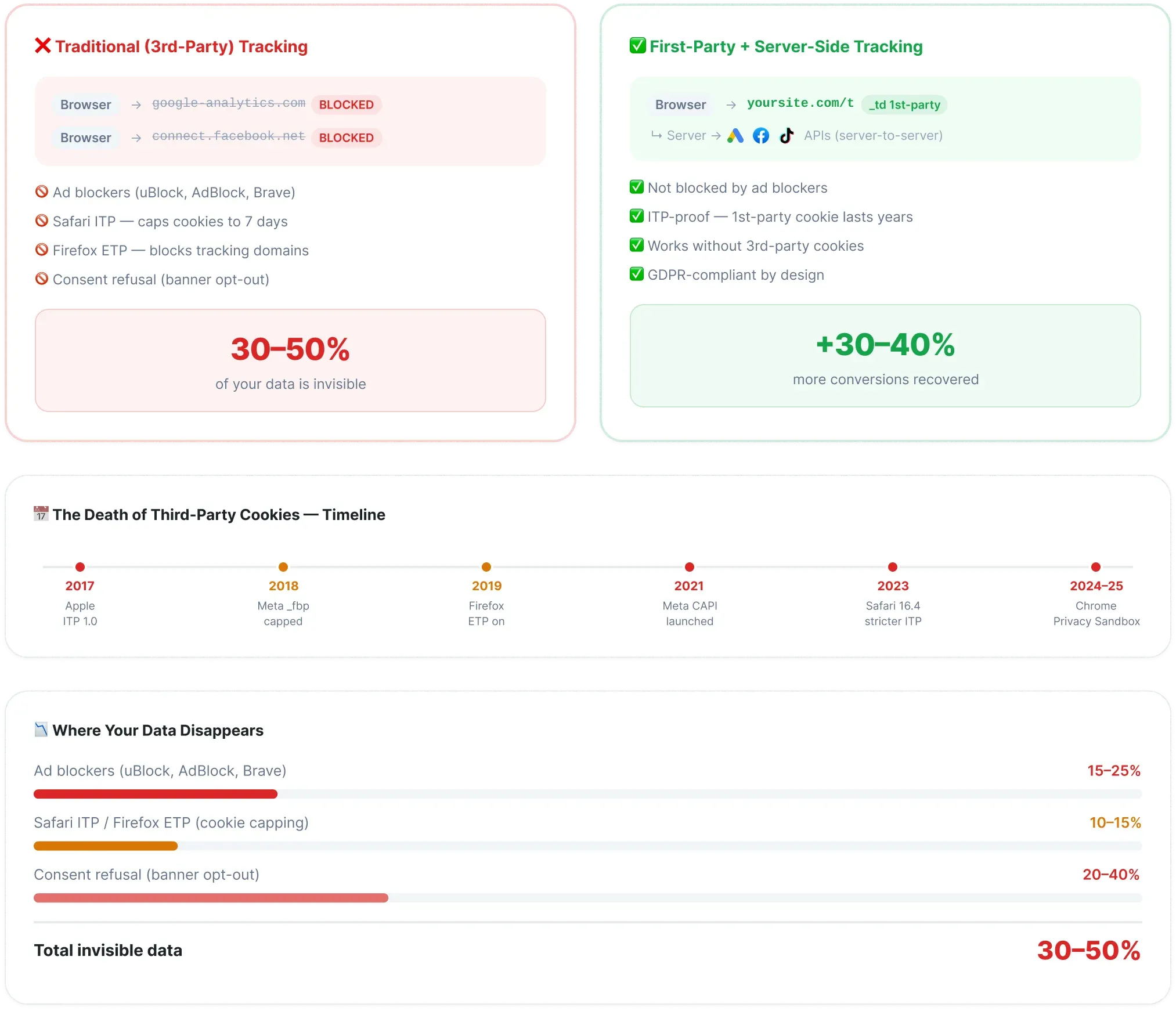
TL;DR: First-party tracking collects data through your own domain instead of third-party scripts. Every major ad platform already uses it: Google, Meta, and TikTok switched to first-party cookies between 2017 and 2019. But first-party cookies alone don't solve the data loss problem. Ad blockers block requests regardless of cookie type, and Safari ITP limits even first-party cookie lifespan to 7 days. The real solution combines server-side tracking with first-party infrastructure to bypass browser restrictions entirely.
What is first-party tracking?
First-party tracking is a method of collecting website visitor data using your own domain and server infrastructure, rather than relying on external third-party scripts like Google's gtag.js or Meta's pixel.
The key distinction isn't what data is collected. It's who sets the cookie and where the request goes. When a visitor lands on your website, traditional tracking loads a JavaScript file from a third-party domain (like google-analytics.com or connect.facebook.net). First-party tracking routes data collection through your own domain (say tracking.yoursite.com) so the browser treats the cookies as first-party.
This matters because browsers trust first-party cookies more than third-party ones. But as we'll see, first-party cookies alone don't solve the full data loss problem.
First-party tracking is not new: a timeline
Many articles present first-party tracking as a recent innovation. This is misleading. Every major ad platform switched to first-party cookies years ago, forced by Apple's 2017 launch of Intelligent Tracking Prevention.
| Date | Event | Impact |
|---|---|---|
| September 2017 | Apple launches ITP in Safari | Third-party cookies blocked; forces the entire industry to adapt |
| September 2017 | Google Ads introduces first-party cookie (_gcl_aw) | Replaces DoubleClick third-party cookies with first-party infrastructure |
| January 2018 | Microsoft/Bing implements first-party tracking | Follows Google's lead |
| October 2018 | Facebook Pixel switches to first-party cookies (fbp, fbc) | Meta fully transitions to first-party cookie model |
| 2019 | Firefox enables Enhanced Tracking Protection by default | Another major browser blocks known trackers |
| 2020–2021 | Meta launches CAPI; Google launches Enhanced Conversions | Server-side tracking era begins, platforms move beyond cookies entirely |
| 2024–2025 | Chrome deprecates third-party cookies via Privacy Sandbox | Last major browser joins; third-party cookies officially dead |
The narrative that first-party tracking is "new" obscures the real story: platforms adopted it 7–8 years ago, and it still doesn't fully solve the data loss problem.
Why first-party cookies alone don't solve the problem
This is where most articles get it wrong. Switching to first-party cookies was the obvious first step, and every major platform took it years ago. But three forces make even first-party cookies unreliable.
1. Ad blockers block requests, not just cookies
This is the critical detail most marketing content skips. Ad blockers like uBlock Origin, AdBlock Plus, and Brave's built-in blocker maintain filter lists (EasyList, EasyPrivacy) that block HTTP requests to known tracking endpoints. They don't care whether the cookie is first-party or third-party. They block the request itself. If your script sends data to a recognized tracking pattern, it gets blocked.
Approximately 40% of users in tech-savvy markets run ad blockers, representing 15–25% of all web traffic lost to request blocking, independent of cookie type.
2. ITP reduces first-party cookie lifespan
Safari's Intelligent Tracking Prevention caps cookies set via JavaScript (document.cookie) to 7 days. A returning visitor who hasn't been to your site in over a week appears as a brand-new user, creating massive gaps in return visitor data. Safari holds ~20% of global web traffic and 30%+ on mobile in Western markets. For B2C businesses, this is significant data loss.
3. ITP also targets CNAME cloaking
Since Safari 16.4 (April 2023), Apple has gone further. If Safari detects that a CNAME record resolves to a third-party domain, even server-set cookies on that subdomain are capped at 7 days. This directly targets the most common workaround (CNAME cloaking) and signals that Apple is actively closing loopholes, not just limiting cookie durations.
| Source | Data Loss | Notes |
|---|---|---|
| Ad blockers | 15–25% | Block HTTP requests to tracking endpoints regardless of cookie type |
| ITP / Safari | 10–15% | Caps first-party JS cookies to 7 days; detects CNAME cloaking |
| Consent refusal (EU) | 20–40% | Users opt out via cookie banners, especially under GDPR |
| Total invisible | 30–50% | Nearly half of conversion events can go untracked |
First-party cookies solve one problem (browser trust) but leave three others wide open: request blocking, time-based restrictions, and consent refusals. This is why the industry moved beyond cookies.
Server-side tracking: the real evolution
The game-changer isn't first-party cookies. It's moving data collection off the browser entirely. Server-side tracking handles events on your server, then sends them directly to ad platforms. The browser is never involved, which means ad blockers and ITP are irrelevant.
How it works in practice: an event occurs on your site (purchase, signup, add-to-cart). Your server captures it, not JavaScript in the browser. Your server then sends hashed first-party data (email, phone) directly to Meta, Google, or TikTok. The platform matches the hashed data to user profiles and attributes the conversion.
The major implementations:
Meta Conversions API (CAPI). Your server sends conversion events to Meta with hashed identifiers. Meta deduplicates against pixel data and matches to user profiles. This bypasses ad blockers and ITP completely.
Google Enhanced Conversions. Hashed first-party customer data (email, phone, address) sent server-to-server to Google Ads. Google matches to signed-in accounts for better attribution.
Google Tag Manager Server-Side (sGTM). A server container running on your subdomain proxies all tracking requests through your infrastructure, giving you full control over data flow.
The result: 20–30% more conversions tracked compared to pixel-only setups.
Critical caveat: server-side tracking still requires consent. Moving tracking off the browser doesn't eliminate the need for consent under GDPR and the ePrivacy Directive. You're still sharing personal data with third-party ad platforms. Server-side tracking changes where data originates (your server vs. the browser), but it doesn't change the legal reality. Anyone marketing server-side tracking as a GDPR workaround is misleading you.
CNAME cloaking: a temporary fix
Some tracking vendors use CNAME cloaking to disguise third-party tracking as first-party. The setup: you create a DNS CNAME record pointing track.yoursite.com to tracker.vendor.com. To the browser and most basic ad blockers, the request looks first-party.
This worked for a few years. But the ecosystem has caught up:
Safari 16.4+ (April 2023). Detects CNAME chains resolving to third-party domains and caps cookies to 7 days, even server-set ones.
Firefox + uBlock Origin. Uses the browser.dns API to resolve CNAME chains in real-time and blocks requests terminating at known tracker domains.
Brave (since v1.17, 2021). Built-in CNAME uncloaking that resolves records and blocks tracker destinations.
DNS-level blockers (NextDNS, Pi-hole, AdGuard Home). Resolve CNAME records at the network level and block if the final destination is a known tracker.
CNAME cloaking is a temporary fix with diminishing returns. It still works against basic ad blockers, but it fails against every major privacy-focused browser and DNS-level protection. It's not a strategic solution. It's duct tape.
How TrustData implements first-party tracking
TrustData takes a different approach: true first-party infrastructure, server-side by design, with no reliance on CNAME cloaking tricks that browsers are actively fighting.
5-minute installation. Add a single snippet to your site. No sGTM container, no Google Cloud project, no complex DNS configuration.
More of the traffic you already have. By combining first-party collection with server-side forwarding, TrustData recovers visits that ad blockers and ITP make invisible to standard implementations.
No CNAME cloaking. No DNS tricks, no temporary workarounds that browsers will break next quarter.
GDPR-compliant by design. Respects consent signals from your CMP. Doesn't pretend server-side = consent-free.
Works alongside GA4. TrustData doesn't replace your analytics. It completes them. You keep GA4 for behavioral analysis while gaining the full picture.
Frequently Asked Questions
Related Reading
Why Is GA4 Missing So Much Traffic?
The four causes of missing traffic in GA4, and how to recover what they hide.
What Is Marketing Attribution?
Every major attribution model explained, and why ad platforms systematically over-count conversions.
What Is Marketing Observability?
The concept that ties tracking, attribution, and monitoring together.
How to Build a Unified Marketing Data Asset
Step-by-step guide to recovering missing conversions and closing the loop with your ad platforms.
14-day free trial
See What Your Analytics Are Missing
TrustData combines first-party infrastructure with server-side forwarding to recover the conversions ad blockers and ITP hide. 5-minute setup, no developer required.