One dashboard, every source
Search Console, your ad platforms, on-site tracking and AI engines, joined against the conversions in your CRM or store (Shopify, WooCommerce).
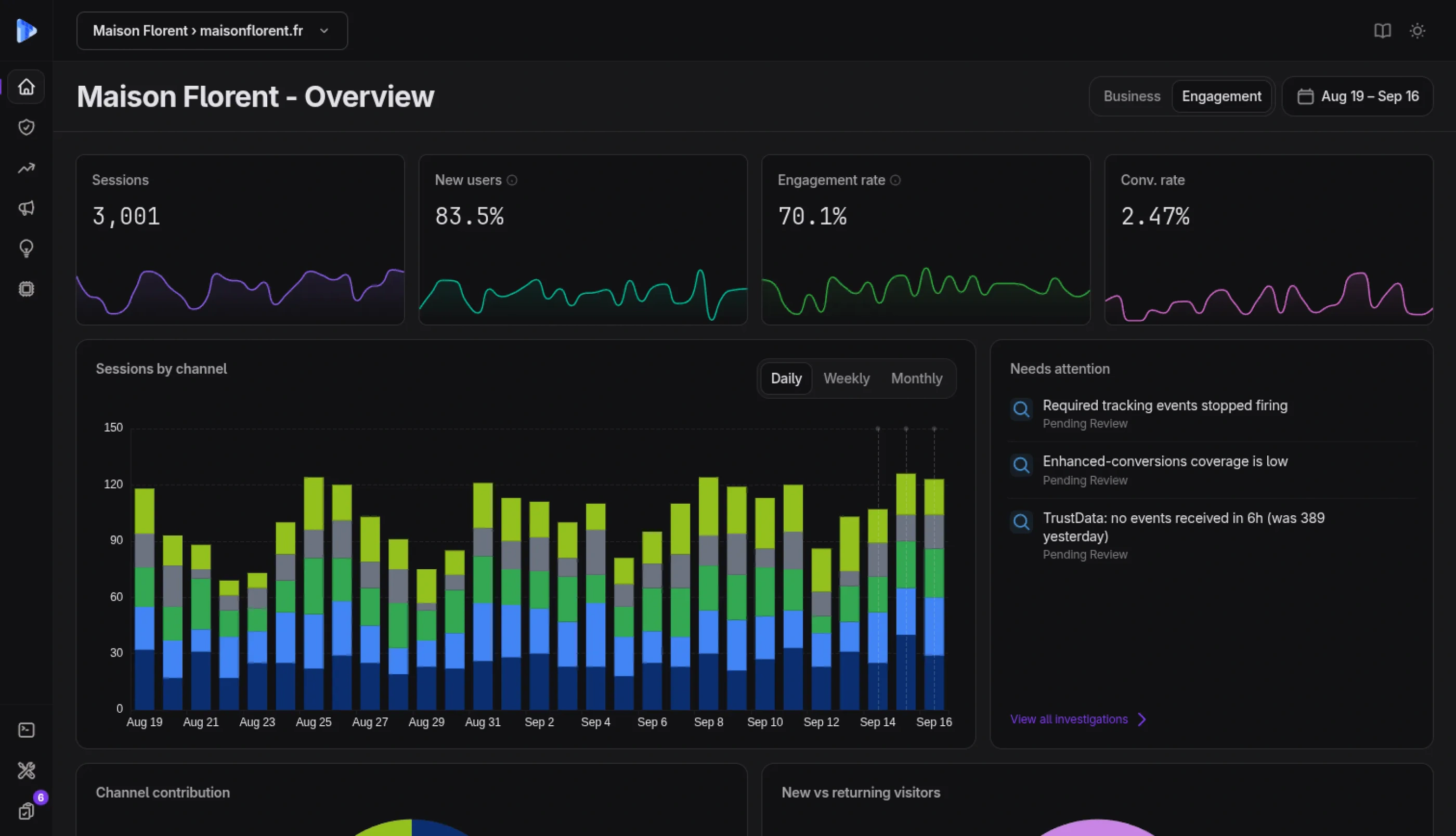
A unified dashboard for the AI era
SEO, SEA, on-site events, AI citations and your real Shopify or CRM conversions, reconciled in real time.
Search Console, your ad platforms, on-site tracking and AI engines, joined against the conversions in your CRM or store (Shopify, WooCommerce).
Claude, ChatGPT and Cursor query your deduplicated data in plain language. Your agents read the same table as your team, not a random extract.
Raw events and attribution tables in Parquet or CSV to your bucket. Compatible with your data warehouse, BI and custom pipelines.
Sample session with scripted answers. The real one reads your data
Observe, Measure, Decide
Google and Meta claim the same sale, a tag breaks without an error, and an agent plugged into that is confidently wrong. TrustData counts one deduplicated conversion, audits the tracking under it, and that is what your agents read.
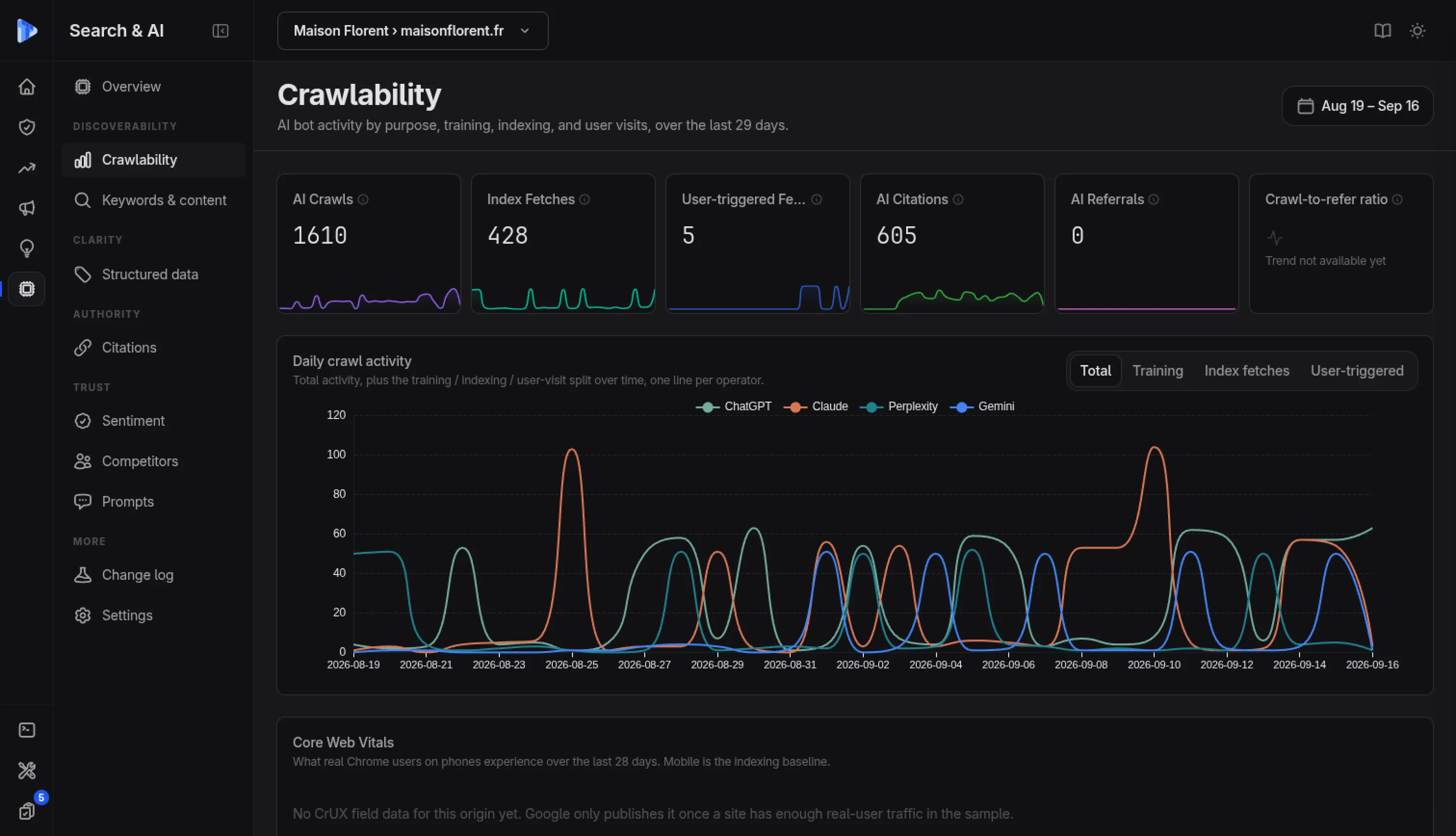
70% of discovery queries get an AI answer. We name the rung costing you citations.
Learn moreYour brand is on ChatGPT. Find out where.
Comparison
An independent source of truth, not another tool to reconcile.
Independent source of truth
TrustData
Platform-independentGoogle Analytics 4
PartialOther tools
Tracking alerts
TrustData
Real-time, automaticGoogle Analytics 4
Other tools
ManualMulti-touch attribution
TrustData
Data-driven (6 models)Google Analytics 4
LimitedOther tools
Biased last-clickAI Visibility (GEO)
TrustData
ChatGPT, Perplexity and AI Overviews includedGoogle Analytics 4
Other tools
Weekly report
TrustData
Google Analytics 4
Other tools
| Feature | TrustData | Google Analytics 4 | Other tools |
|---|---|---|---|
| Independent source of truth | Platform-independent | Partial | |
| Tracking alerts | Real-time, automatic | Manual | |
| Multi-touch attribution | Data-driven (6 models) | Limited | Biased last-click |
| AI Visibility (GEO) | ChatGPT, Perplexity and AI Overviews included | ||
| Weekly report |
Full platform
Every layer runs on the same first-party event and one deduplicated conversion, collected at the source. That is why the numbers agree.
Recover the visitors a client-side tag never sees. Served from your own domain, so a blocklist has no host to match.
Catch the broken tag before it costs you a month of data. The audit names the defect and its fix, not a red dot.
Stop reconciling Meta, Google and Shopify by hand. One deduplicated conversion sits under every channel.
Find the one rung costing you citations. Your SEO lead ships a fix this week instead of staring at a score out of 100.
Work a ranked list instead of debating one. Every recommendation carries how often that rule has been right.
Agencies get the Portfolio, per-client isolation and white-label reports, with the rate down 10% from the fifth client.
Resources
Hands-on guides on first-party tracking, multi-touch attribution and AI visibility, and why platform ROAS runs 30 to 50% high.
Article 01
AI visibility measures how often your brand appears in AI-generated answers across ChatGPT, Gemini, Perplexity, and other engines. This guide covers what it is, why it matters for e-commerce, and how to measure it.
Article 02
A step-by-step guide to getting your brand cited in ChatGPT, Gemini, Perplexity, and other AI engines. Covers the content changes that actually move the needle, with before/after examples.
Article 03
A side-by-side comparison of the tools that track your brand across ChatGPT, Gemini, Perplexity, and other AI engines. Covers TrustData, Otterly.ai, Profound, Semrush, and BrightEdge with pricing, features, and engine coverage.
FAQ
Because they grade their own homework. Each platform optimizes its reporting to show you the best possible ROAS. Google and Meta often both claim 100% credit for the same conversion, which can inflate your reported ROAS by 30–50%. TrustData cross-references your real conversions (Shopify, CRM) with platform spend data to calculate an actual ROAS, independent of what each platform declares.
GA4 is a web traffic analysis tool. TrustData is an independent marketing measurement platform that reconciles your real sales data with ad spend data to tell you what's actually driving revenue, independent of platform self-reporting. TrustData also covers observability (alerts when your tracking breaks) and decision-making (weekly reports, budget recommendations).
Because the agent will answer confidently on whatever it is given, and GA4 hands it a sample cut by ad blockers and Safari, with each ad platform's own count of the same sale. TrustData hands it one deduplicated conversion taken from your store or CRM, with the tracking audited underneath, so the agent reasons on what sold rather than on what each platform claimed. The MCP server ships on every tier.
TrustData deduplicates conversions at the data layer. When multiple ad platforms all report the same conversion, TrustData cross-references them against a single source of truth (your Shopify or CRM data) and assigns one deduplicated credit. You get an accurate ROAS per channel instead of inflated numbers from each platform's native attribution.
Yes. TrustData uses dual tracking logic. Without consent, it applies anonymous server-side tracking with hashed IP and User-Agent, no personal data stored. With consent, full tracking activates for attribution and conversion syncing. All data is EU-hosted.
14-day free trial
14-day free trial with 500,000 pageviews a month included. Live in 5 minutes, no credit card.