Four silos
Rank a broken tag against a paid move
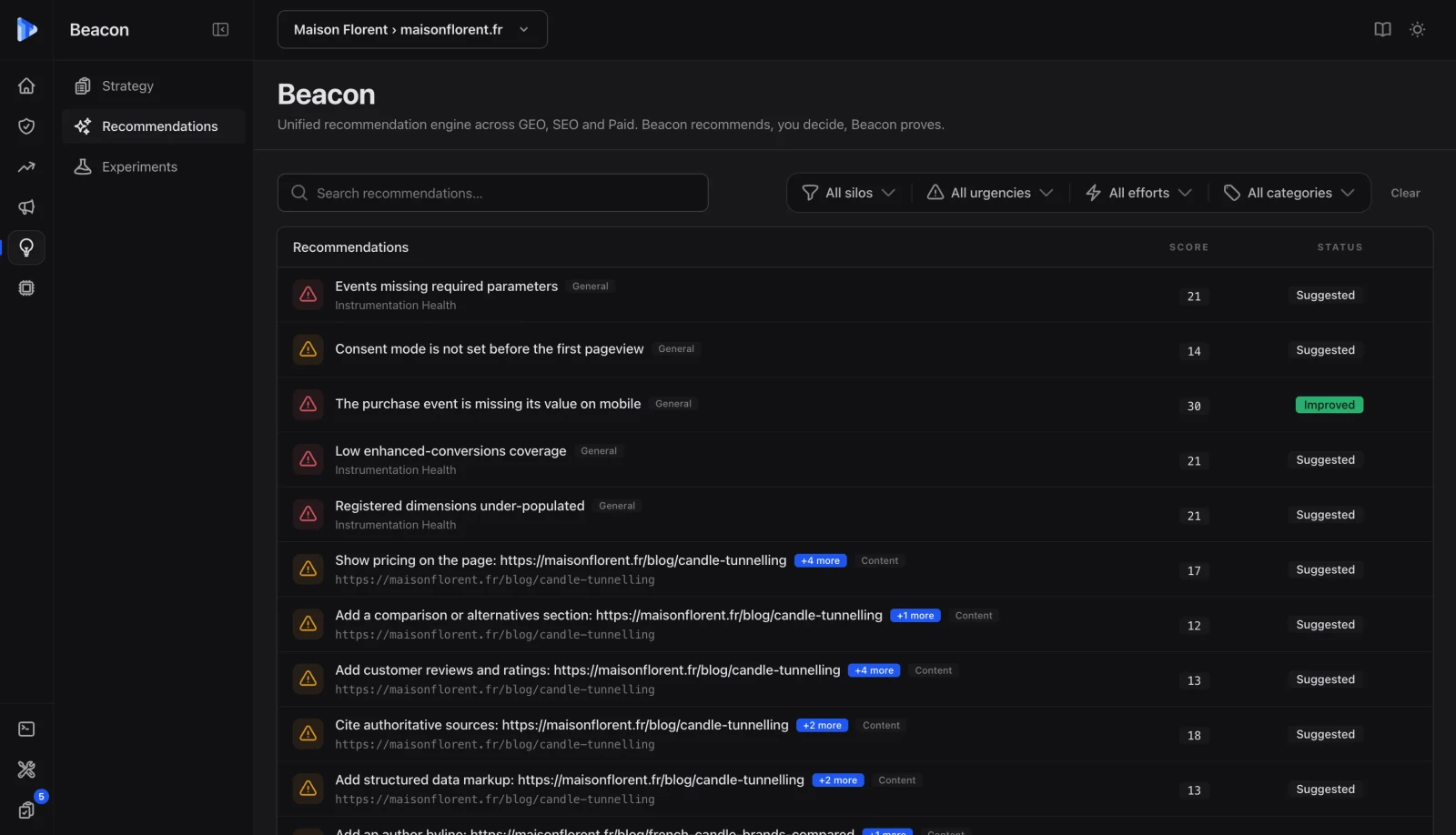
Rank a broken tag against a paid move in one list. Instrumentation is the silo nobody else has, fed straight from the tracking audits.
Key takeaway
Every tool ships recommendations. Almost none of them tell you whether their own advice worked. Beacon keeps a record per rule of how often it fired, how often you acted, and how often the outcome was a win, and it orders the feed by that record.
One feed
A tracking defect, a missing schema block, a keyword you rank fourth for and a campaign past its saturation point are four different problems in four different tools. Here they are four rows in the same list, competing on urgency and effort rather than on which tab you happened to open.
Rank a broken tag against a paid move in one list. Instrumentation is the silo nobody else has, fed straight from the tracking audits.
Each row carries an urgency, an effort level and a category, and the list sorts on a score built from all three.
Plan, Done or Dismiss, with each row moving from suggested to to-do to verified and the stage visible in a status column.
One full page per recommendation shows what fired it, the evidence behind it and what happened afterwards.
Strategy
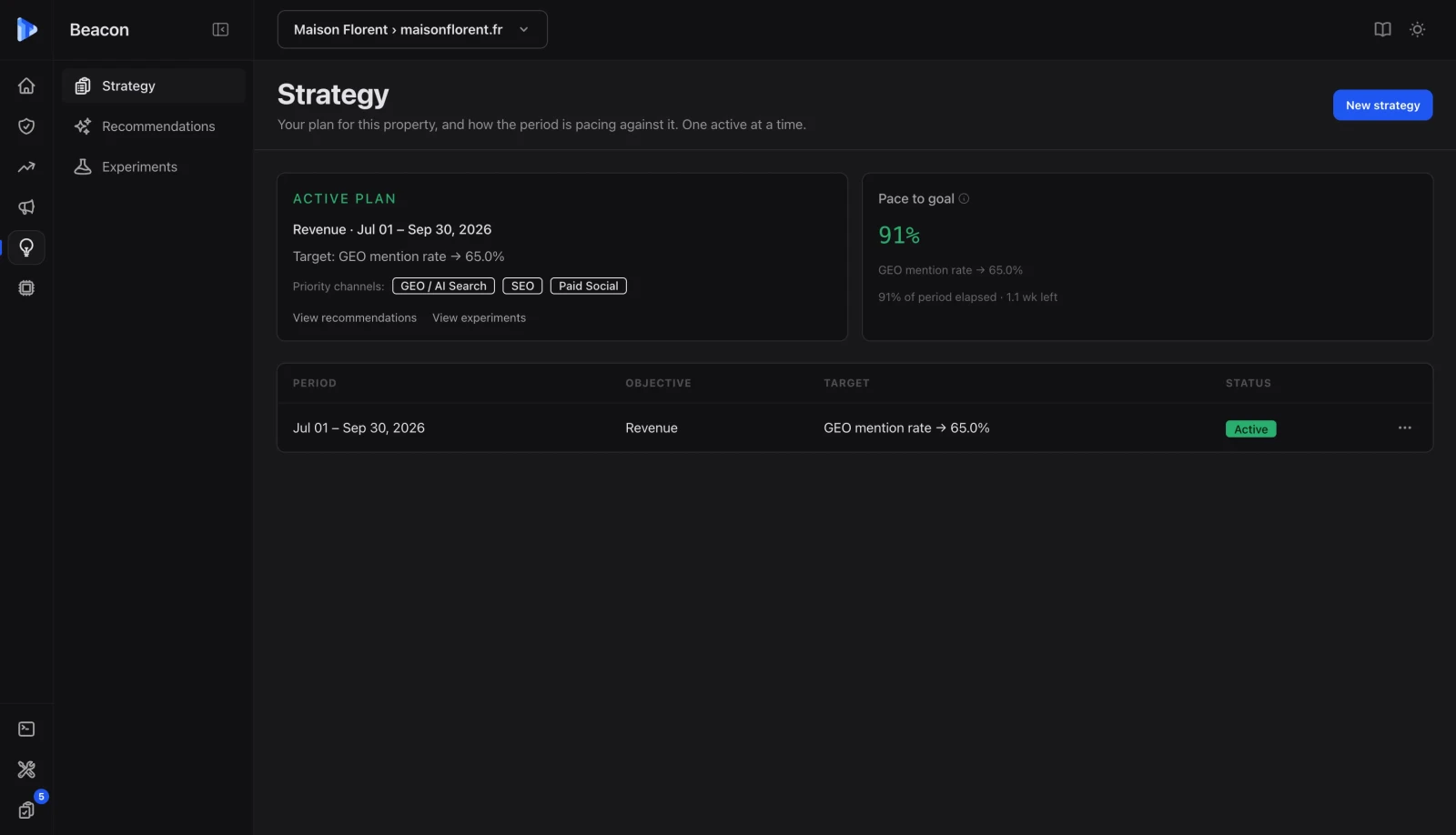
Most recommendation engines optimise in a vacuum, so they will happily tell you to cut the channel that is building the audience you said you wanted. A strategy is the plan the weekly narrative reasons against, and it changes what gets recommended.
A month, a quarter or a year with an objective of leads, revenue or brand. Activating a new plan archives the old one.
Six metrics: conversions, paid revenue, conversion rate, sessions, blended paid ROAS, GEO mention rate. The list is fixed on purpose.
Set the budget and priority channels once. The plan reads the personas and competitors you already defined.
A narrative each week over the period so far, paced against your target and ending in what to move.
Governance
This is the part that should be uncomfortable to publish. Each rule carries a running count of how often it fired, how often it was followed, how often the follow-up concluded, and how often it won. A rule that keeps losing gets demoted in the ranking.
Four counts per rule, kept as a contract rather than a dashboard widget: publish the number that could embarrass us.
A precision verdict sits alongside the counts, so demoting a rule with plausible advice and poor outcomes is an evidence decision.
One verdict rule covers every silo, because a win meaning ten mention-rate points here and two positions there ranks nothing.
One row, as it renders
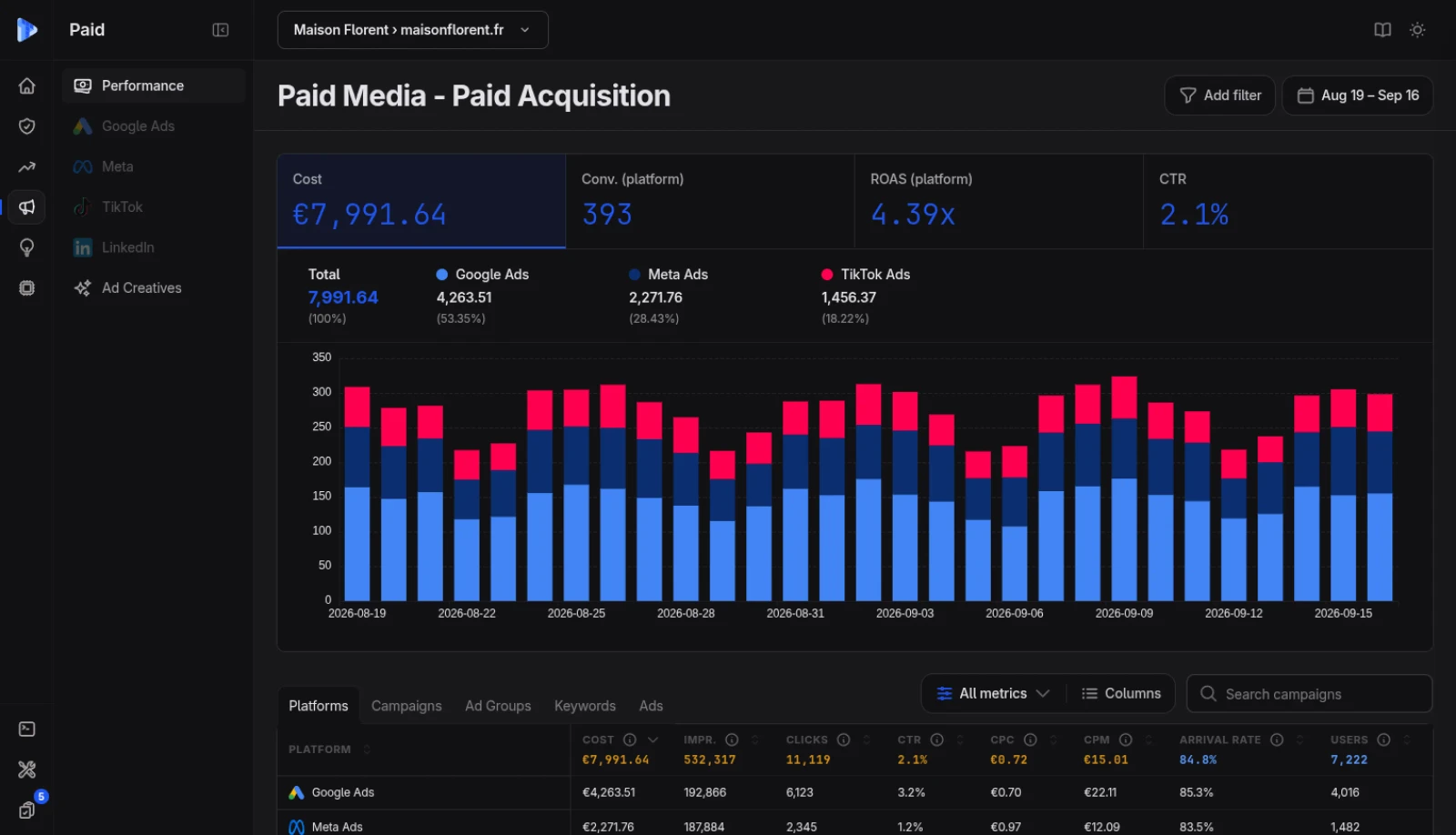
What fired it, the urgency and effort, the 14-day verdict, and the record of the rule that produced it.
Move 640 EUR a week from Meta Prospecting to Google Performance Max
FAQ
Two things. The first is that every rule keeps a public record of its own outcomes: how often it fired, how often you acted on it, how often the follow-up concluded, and how often the result was a win. That record orders the feed, so a rule that keeps being wrong sinks. The second is that the four silos share one queue and one verdict definition, so a tracking fix and a paid move are comparable rather than living in separate tools with separate notions of success. Most engines can tell you what they recommend. Very few can tell you how often they have been right.
Four silos. GEO covers AI visibility work: crawl access, extractability, citation gaps, sentiment. SEO covers keyword and content opportunities. Paid covers spend allocation, saturation and creative. Instrumentation covers tracking defects, and it is fed directly by the Trust Center audits and investigations, which is the join most stacks do not have: the tool that finds your broken tag is usually not the tool that queues the fix.
A strategy is one active, time-bounded plan per property: an objective of leads, revenue or brand, a target metric with a value, a budget, priority channels, and the personas and competitors you already defined elsewhere. The weekly synthesis paces against it instead of narrating metrics in isolation. The target metric comes from a fixed list of six because the pacing has to be able to compute progress period-to-date from data that exists. Free text would let you set a goal that silently never gets scored. Paid revenue is named that way for the same reason: the only revenue figure the pacing can read is the paid platform summary, so a goal set against total revenue would be judged on the paid slice of it.
No. Every recommendation needs a human to plan it, and the three actions are Plan, Done and Dismiss. The feed proposes the move; nothing changes in an ad account without you. That is a deliberate line, not a missing feature: an engine that publishes its own hit rate is an engine that admits it is sometimes wrong, and something that is sometimes wrong should not have your card.
Optimize and above. It sits at the same tier as the AI engine probes because Beacon reads probe output, and gating a consumer above its producer means it runs with nothing to read. Measure gives you the measurement layer: first-party tracking, deduplicated attribution, AI visibility and SEO keyword intelligence. Optimize is where the system starts telling you what to do about it.
14-day free trial
14-day free trial. Beacon is included from Optimize, with the strategy, the weekly read and the rule record it keeps on itself.