Presence
Measure your presence, question by question
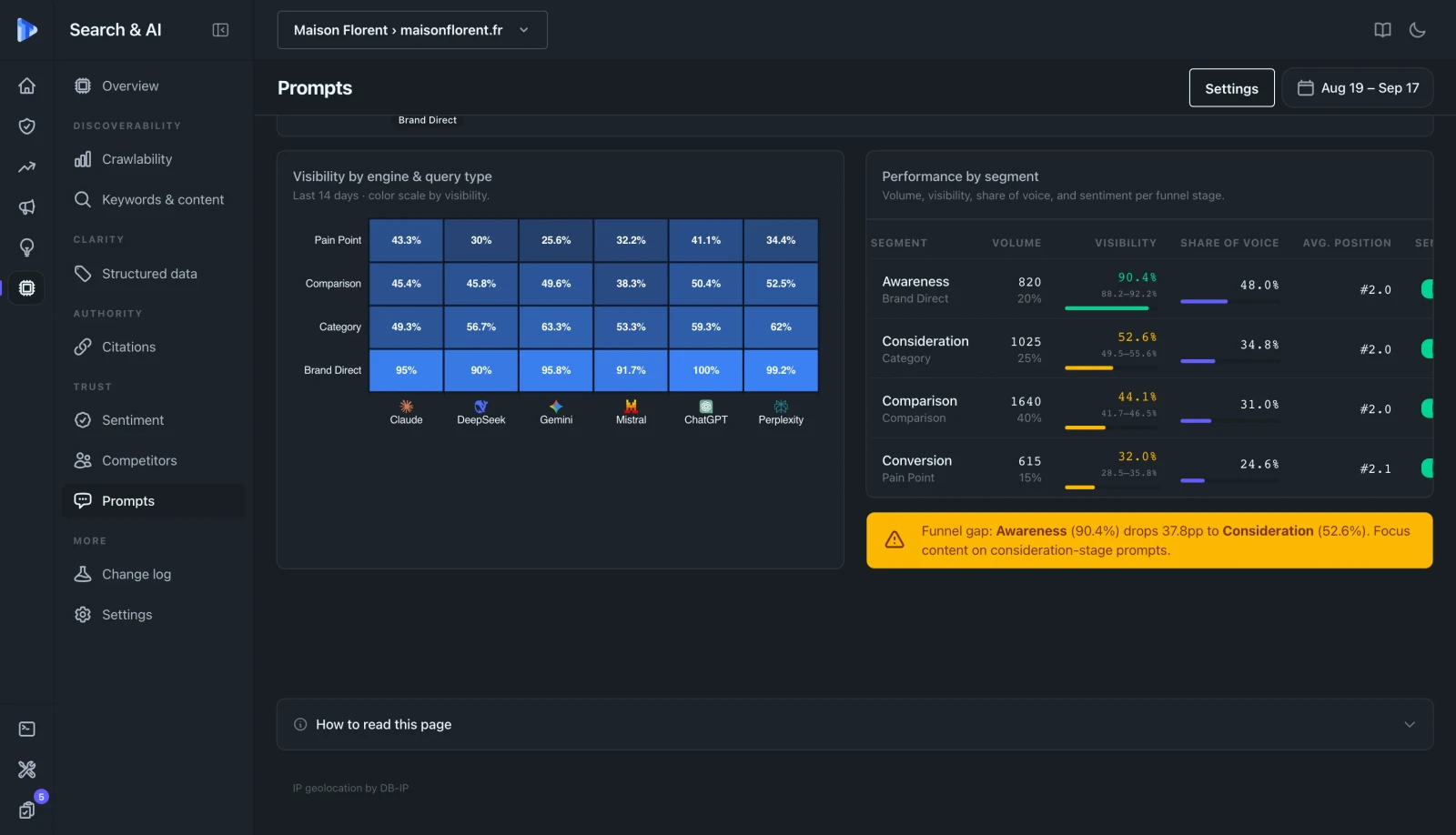
Mention rate and share of voice per engine and per question type: brand, category, comparison, pain point.
Key takeaway
Every AI answer is kept in full, with and without web search. Every number traces back to a sentence you can read, and the gap between the two modes tells you whether the problem sits in the model or in your content.
What you see
On the questions your buyers ask, each probe records whether you appear, what is said about you, which sources are cited and which competitors are named.
Mention rate and share of voice per engine and per question type: brand, category, comparison, pain point.
Every mention classified positive, neutral or negative over 14 days, with the full answer behind each classification.
The domains cited alongside you, and the ones cited instead of you when a competitor is named: your outreach list.
The competitors you name are tracked in every probe, with their share of voice per engine against yours.
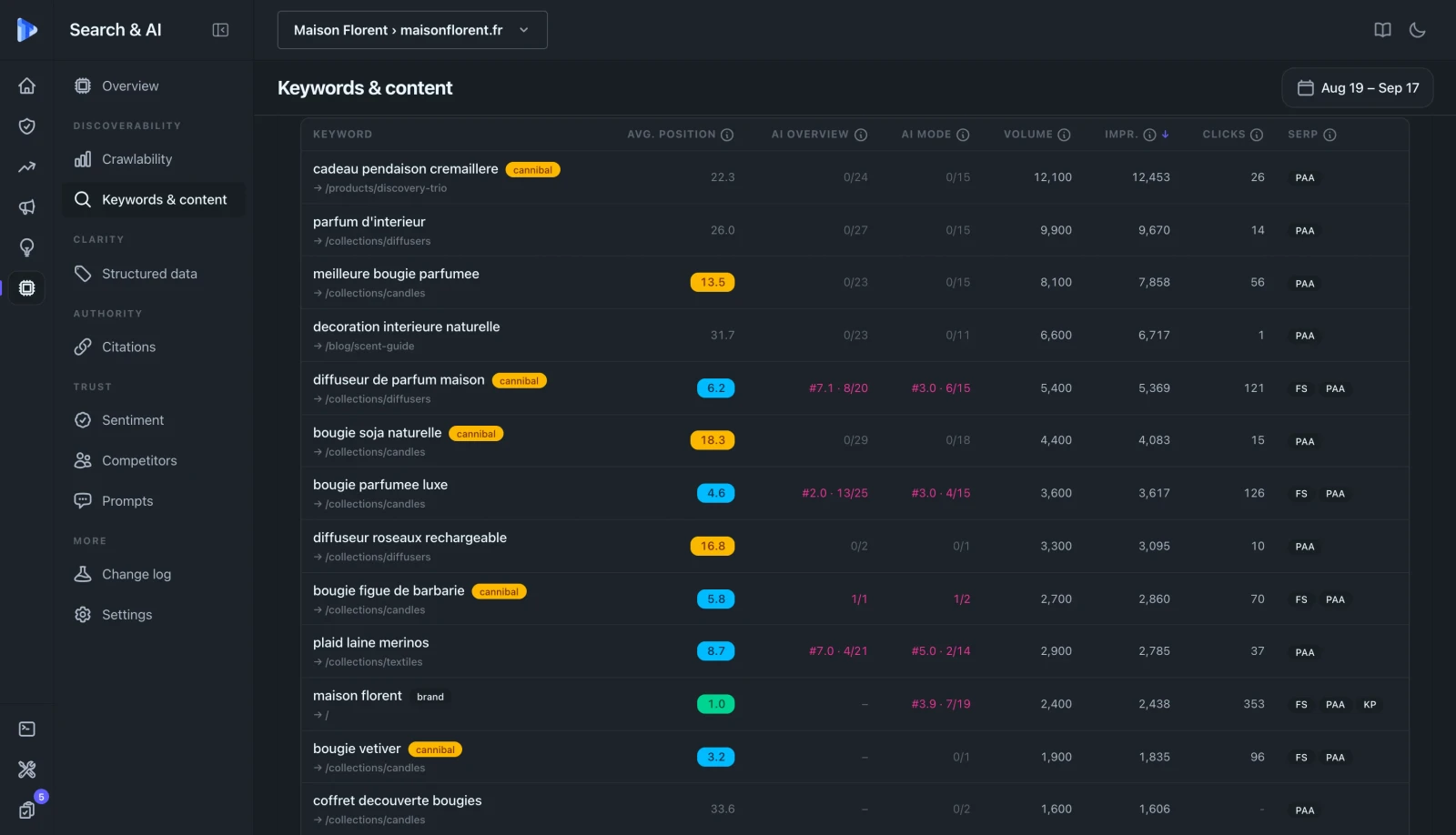
An AI Overview does not show on every search, or for everyone. AI Mode is a second answer with its own sources. For each keyword you see how often each appears and whether you are cited in it.
Every keyword carries how often an AI Overview appeared over four weeks, with the number of readings behind it.
Your position among the sources when an Overview appears, and the snippet Google took from your page.
AI Mode writes its own answer instead of summarising the results: being cited in the Overview guarantees nothing here.
AI Overview state sits on the same row as your impressions, clicks and conversions, so lost link and won citation read together.
Engines and probes
Every probe runs in two modes, with live web search and without. The gap between them separates what the model knows from what it just read.
ChatGPT, Perplexity and Google AI Overview ship with every tier. Gemini, Claude, Mistral and DeepSeek are add-ons from 15 EUR a month.
Strong with search and weak without puts you in the index but not the model. Weak both ways means the content is not extractable.
Score brand direct, category, comparison and pain point separately, because each maps to a different buying stage and fails differently.
Why we built it
A separate AI visibility tool gives you a score, and reconciling it with your sales happens afterwards in a spreadsheet. Here, ChatGPT is a channel like Meta or Google: same dashboard, same orders, same decisions.
Visits from ChatGPT or Perplexity are recognised, as in GA4, and read beside your other channels: sessions, conversion rate.
The first-party SDK that counts your sales reads every request's user agent, so AI crawler access arrives without a log export.
ChatGPT, Perplexity and AI Overviews ship in all four tiers, next to attribution and tracking integrity.
The prompts come from your audience, every answer is kept, and no visibility number is ever converted into revenue.
Generated from your personas and real search demand, suggested in bulk and then edited by you. 50 prompts on Measure, 400 on Prove.
Every probe keeps the whole answer, the cited domains and the competitors named, so a row can be checked before anyone acts on it.
Six signals scored separately against a cut-off of 60, and exactly one named as the thing to fix first. No blended score.
Citation rate and share of voice ship with their noise level. AI-referred visits are read as sessions and conversion rate, not as caused revenue.
Crawl access, extractability, citations, tone and prompt coverage, each measured on its own terms rather than averaged into a score.
Who reads your pages when the visitor is an engine rather than a browser, from your logs, and whether a citation followed.
Structural bands with a floor and a ceiling, published as numbers rather than folded into a letter grade.
Owned and earned kept apart rather than averaged, and the co-cited list read as an outreach brief.
How you are described when you are mentioned, with linked and unlinked mentions counted apart.
The questions your buyers actually ask, and a stability metric that can disprove our own prompt set.
Otterly, Peec, Profound and Semrush's AI add-on compete on engine logos and a score. The comparison that matters is what happens after the score.
The headline number
TrustData
The signal to fix first, namedStandalone GEO tools
A visibility score or share of voiceSEO suites with an AI add-on
Share of voice inside the SEO reportAI crawler access
TrustData
Read server-side by your first-party trackingStandalone GEO tools
Separate log integration, where offeredSEO suites with an AI add-on
Beside your paid and SEO conversions
TrustData
Standalone GEO tools
SEO suites with an AI add-on
SEO onlyEngines in the base plan
TrustData
ChatGPT, Perplexity, AI Overviews, four more as add-onsStandalone GEO tools
Often more logosSEO suites with an AI add-on
Per enterprise contractEntry price
TrustData
199 EUR a month, attribution and tracking includedStandalone GEO tools
From USD 29 a month, monitoring onlySEO suites with an AI add-on
On quote, enterprise seat| Feature | TrustData | Standalone GEO tools | SEO suites with an AI add-on |
|---|---|---|---|
| The headline number | The signal to fix first, named | A visibility score or share of voice | Share of voice inside the SEO report |
| AI crawler access | Read server-side by your first-party tracking | Separate log integration, where offered | |
| Beside your paid and SEO conversions | SEO only | ||
| Engines in the base plan | ChatGPT, Perplexity, AI Overviews, four more as add-ons | Often more logos | Per enterprise contract |
| Entry price | 199 EUR a month, attribution and tracking included | From USD 29 a month, monitoring only | On quote, enterprise seat |
FAQ
AI visibility monitoring tracks how your brand appears in AI-generated answers across engines like ChatGPT, Perplexity, Gemini and Claude, and in Google AI Overviews. Over 70% of discovery queries now return a zero-click AI answer: category research, comparisons, recommendations. Where your brand appears in those answers, or fails to, directly affects traffic. TrustData probes ChatGPT and Perplexity daily on every plan, reads AI Overviews per keyword, and keeps every answer in full.
If monitoring is all you need, that is often the right answer: Otterly's Lite plan starts at USD 29 a month for 15 prompts, pricing checked August 2026. TrustData starts at 199 EUR because AI visibility arrives with the rest: the first-party tracking that sees the crawlers pass, the traffic ChatGPT sends read as a channel beside the others, and the attribution of your Meta and Google spend on one deduplicated conversion. You are buying the join, not the probe. On engines included in the base plan, Otterly is ahead, four against three, so compare depth per prompt rather than logos.
Because an average hides the one thing you can act on. A brand can be crawled thoroughly and still be invisible in answers, or be mentioned constantly and never referred. Blending six signals into one number tells you that something is wrong without telling you what. TrustData scores each signal separately against a cut-off of 60, then names exactly one thing to fix first: the lowest signal below the cut-off whose prerequisites are already clear. A signal with too little data reads as insufficient data rather than as a zero.
AI Overviews are read per tracked keyword and reported as a presence rate over four weeks with the number of readings behind it, because an Overview does not show on every search or for everyone. When it appears, we record whether you are cited, in which position, and the snippet taken from your page. AI Mode is a separate answer with its own sources: it is read once per tracked keyword and billed per keyword, from 29 EUR. Both sit side by side on the same row as your impressions, clicks and conversions, never blended into one Google score.
TrustData probes 6 engines: ChatGPT, Perplexity, Gemini, Claude, Mistral and DeepSeek, and reads two Google surfaces, AI Overviews and AI Mode. ChatGPT and Perplexity are included in every plan, with AI Overview tracking. Gemini (25 to 199 EUR), Claude (99 to 799 EUR), Mistral and DeepSeek (15 to 99 EUR each) are per-engine, per-tier monthly add-ons. Google AI Mode is read once per tracked keyword rather than probed, so it is priced per keyword at 29 to 299 EUR. There is no per-probe overage: engine cost is included in the add-on price and volume caps at your tier's probe budget. Grok was dropped in July 2026 because it never returned a usable row.
The Brand Health Score is a 0 to 100 composite measuring how consistently your brand appears in AI answers. It is a weighted average of your with-search mention rate (60%) and no-search mention rate (40%) across all engines and question types, updated daily. It returns no value at all below 5 probes rather than reporting a number built on noise. It is a supporting metric. The diagnosis that names the signal to fix, not this score, is how you decide what to do next.
We do not claim that, and we will not report it as if we could. Paid media, audiences and smart links are measured causally through holdout tests, with confidence intervals. AI visibility, content and SEO are measured as leading indicators: citation rate, share of voice, ranking lift, each with its noise level. AI-referred visits are read as sessions and conversion rate, like any channel, not as caused revenue. Any tool telling you it has attributed revenue to a ChatGPT citation is overstating what the data can carry.
14-day free trial
14-day free trial. AI visibility is included in every plan, with ChatGPT, Perplexity and AI Overview tracking on every tier.