Native sync
Catch the order even when the browser drops it
Orders, products and customers sync natively with webhooks, so a sale is recorded even when the confirmation page never fires.
Key takeaway
The specific way a Shopify engagement goes wrong is not bad analysis. It is a theme update or an app install that quietly breaks checkout tracking, three weeks of numbers nobody can defend, and a client who noticed before you did. Finding it first is the difference between a maintenance ticket and a lost account.
The stack
A Shopify agency lives with a specific problem: the store knows exactly what sold, and every other system is guessing at it. Starting from the order removes the guess.
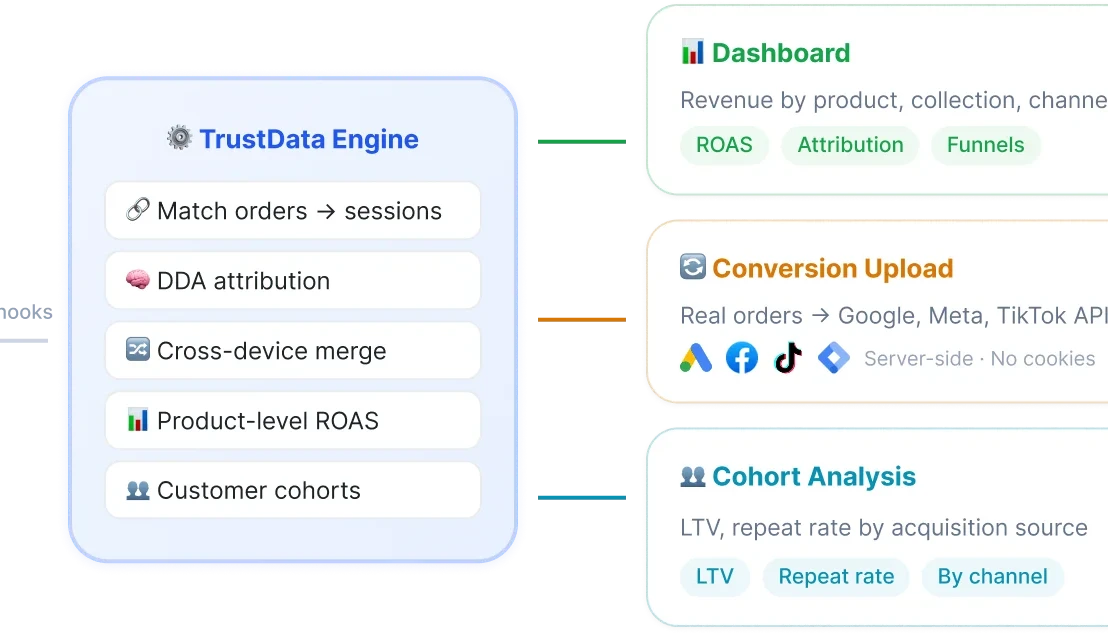
Orders, products and customers sync natively with webhooks, so a sale is recorded even when the confirmation page never fires.
Platform claims are reconciled against the store's own orders, and the gap is typically 30 to 50%.
The native app needs no code, which matters when the theme is the thing that keeps breaking.
The break
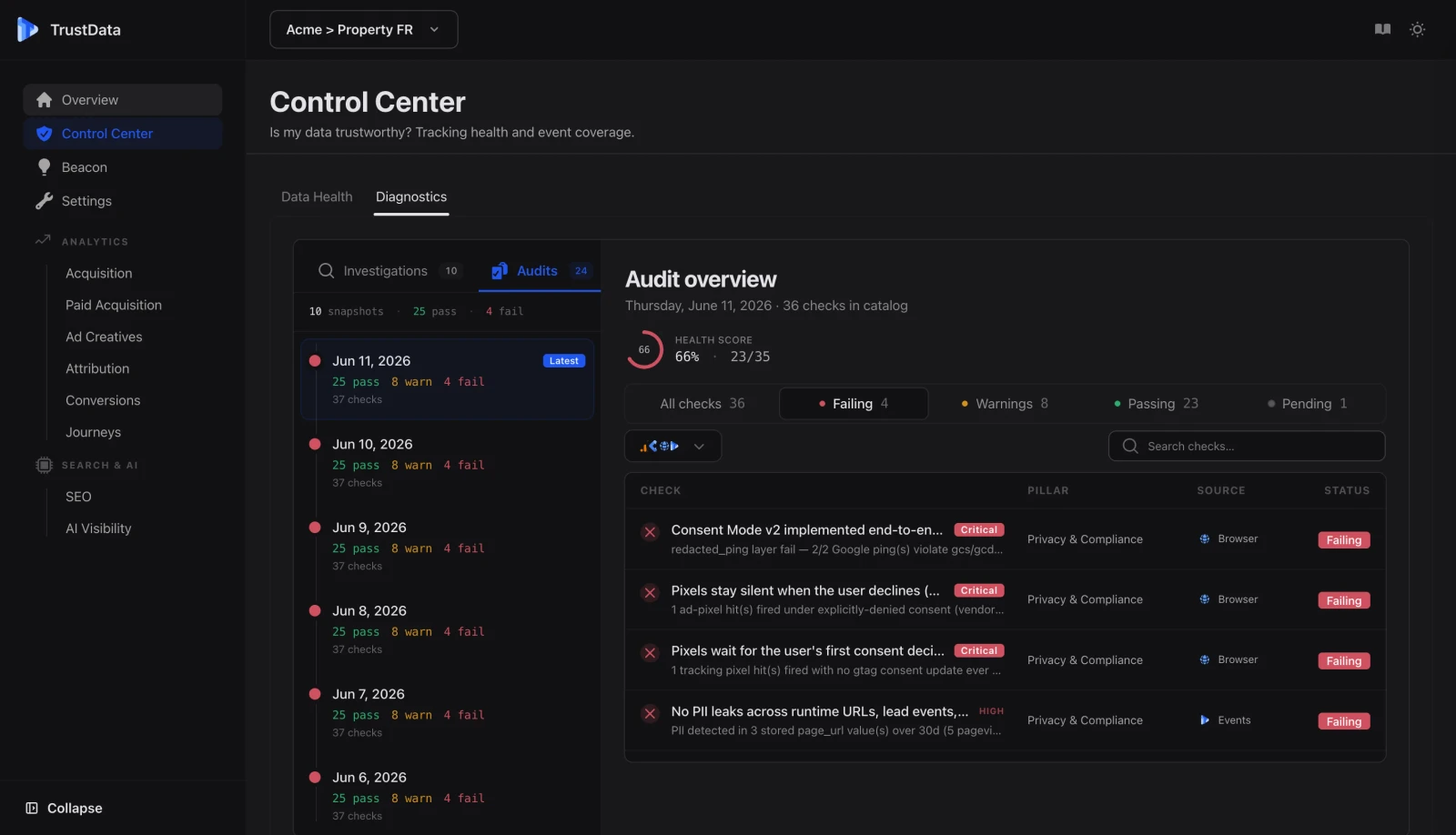
Theme updates, app installs and checkout extensibility changes all break tracking in ways that produce a chart rather than an error. The dashboard keeps drawing a line, and nobody notices for weeks.
Tag manager config and security, consent and privacy, ecommerce schema and runtime payload, with ecommerce checks applying in full.
When conversions drop the investigation runs the integrity checks first, because a tracking fault makes everything downstream meaningless.
The tracking plan states every expected event and grades itself live against what actually fires.
The book
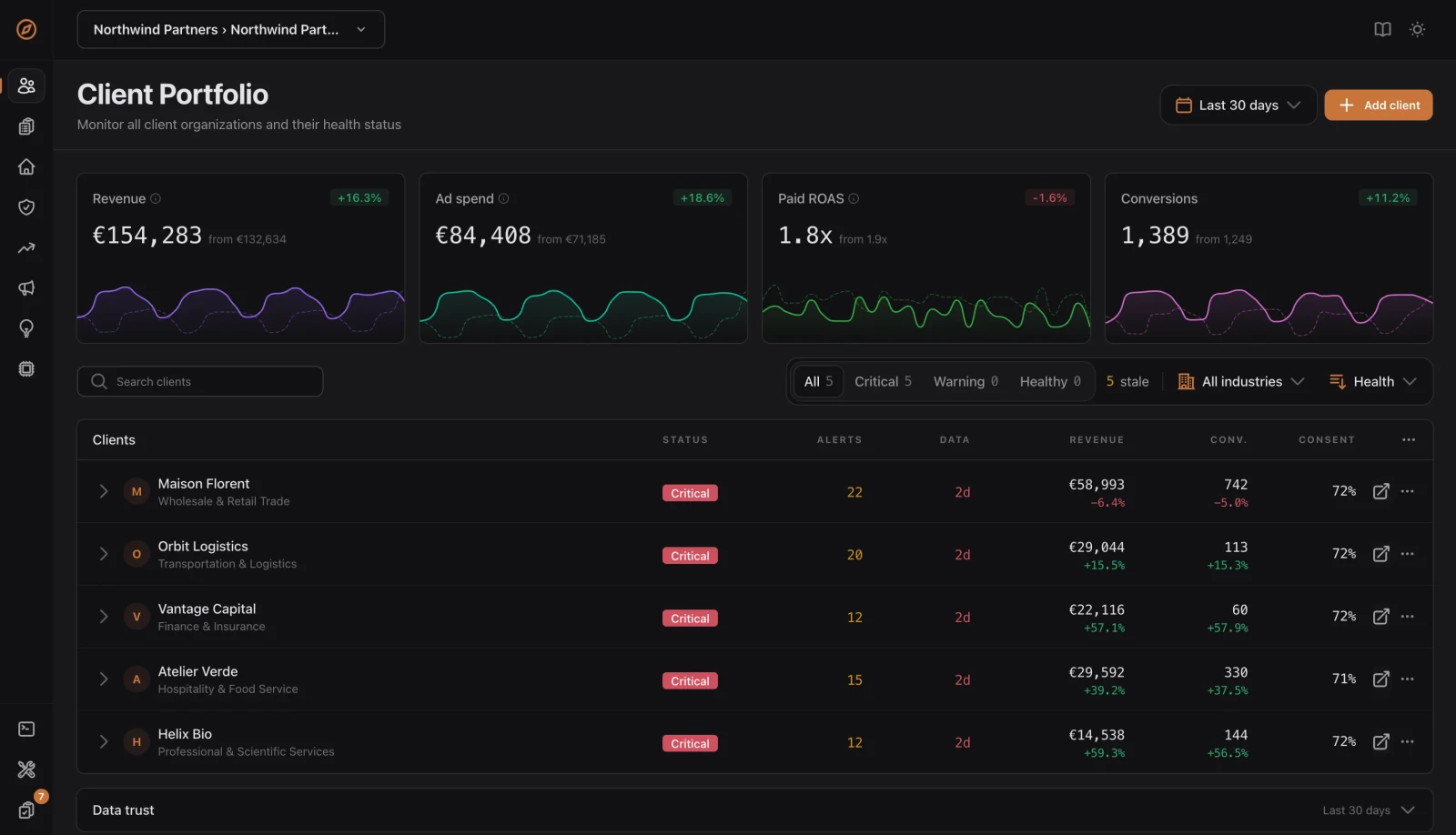
A Shopify agency's economics are per store, so the tooling has to be too. One account across the book, with data kept apart and each store on the tier that fits its stage.
Every store in one view a click apart, fully isolated, with access set to full, read-only or report-only.
Your logo, your domain, your colours, with no export step and no slide contradicting a screen.
Prospects monitored weekly with their AI share of voice and how it moved, ranked so the list opens on whoever just dropped.
FAQ
Theme updates that drop a snippet, app installs that inject a competing pixel, checkout extensibility changes, and consent banner swaps. All of them produce a chart rather than an error, which is why they run for weeks. The audit reads your tag manager, your analytics configuration and the pages themselves, so a missing purchase event or a duplicate tag surfaces as a named finding with a remediation rather than as a slow drift you rationalise.
No. Shopify knows what sold and it is the source of truth here, which is the point. What Shopify cannot tell you is which channel caused the sale, how much your ad platforms over-claimed, or whether a visitor who bought had been on the site three times before. That is the layer this adds, and it starts from Shopify's own orders rather than from a pixel's guess at them.
A tracking app forwards conversions and stops there, which is genuinely enough for some clients. This starts at the same place and continues into attribution across channels, AI visibility, and a ranked queue of what to do about it. If your clients need conversion forwarding and nothing else, a cheaper single-purpose app is the honest recommendation and we would rather say so.
Yes. The JavaScript SDK works with any stack, and orders can arrive from a CRM or your own backend by webhook. Shopify has a native integration that makes it the fastest path, but the book does not have to be homogeneous, and mixing store platforms across clients changes nothing about how the account is structured.
Per client, with volume discounts by client count, and every connector included on every tier so a smaller store is not handicapped on data sources. Each store sits on the plan that fits its stage. Below roughly 50,000 EUR monthly ad spend on a given client, a cheaper single-purpose tool is usually the right buy for that client, and saying so is what makes the rest of this credible.
14-day free trial
14-day free trial. Native Shopify sync, the tracking audit and per-client isolation are on every plan.