Multi-client
See every client's alerts on one screen
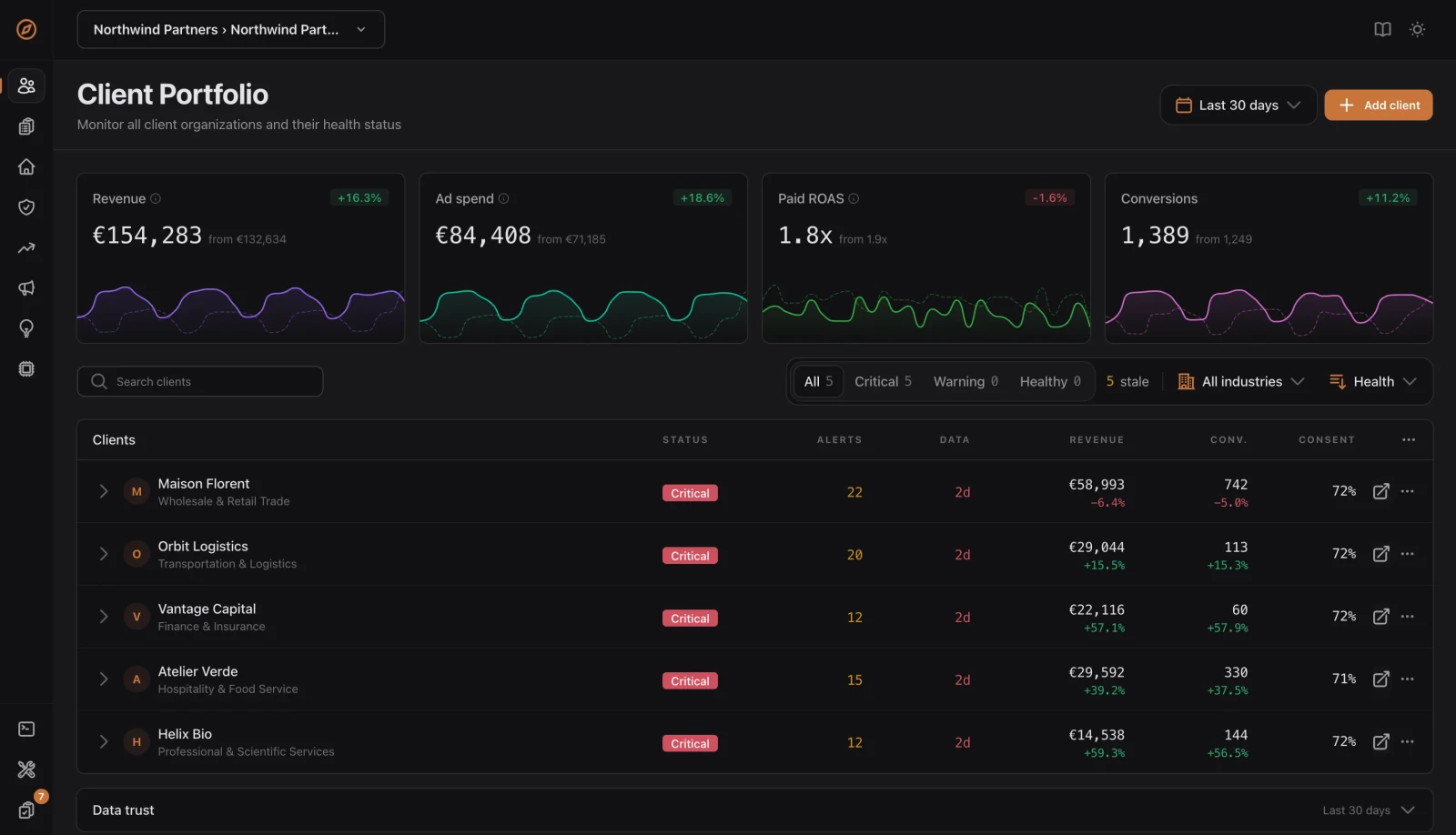
Revenue, open alerts and consent rate per client, on data kept fully apart, so switching is a context change and never a filter.
Key takeaway
A client who finds a broken tag before you do is an account at risk. Here the audit finds it first, and the report carries a number you can defend.
Portfolio
Everywhere else, twenty clients means twenty logins, and one wrong tab shows a client someone else's number. Here every client sits on one screen with revenue, alerts and consent rate. You know who needs you first before you open anything.
Revenue, open alerts and consent rate per client, on data kept fully apart, so switching is a context change and never a filter.
Full dashboard, read-only, report-only or none, because forcing a PDF client to log in loses accounts and so does the reverse.
Moving a client up is a change you make rather than a renegotiation, so a small client never carries a big one's cost.
Trust Center
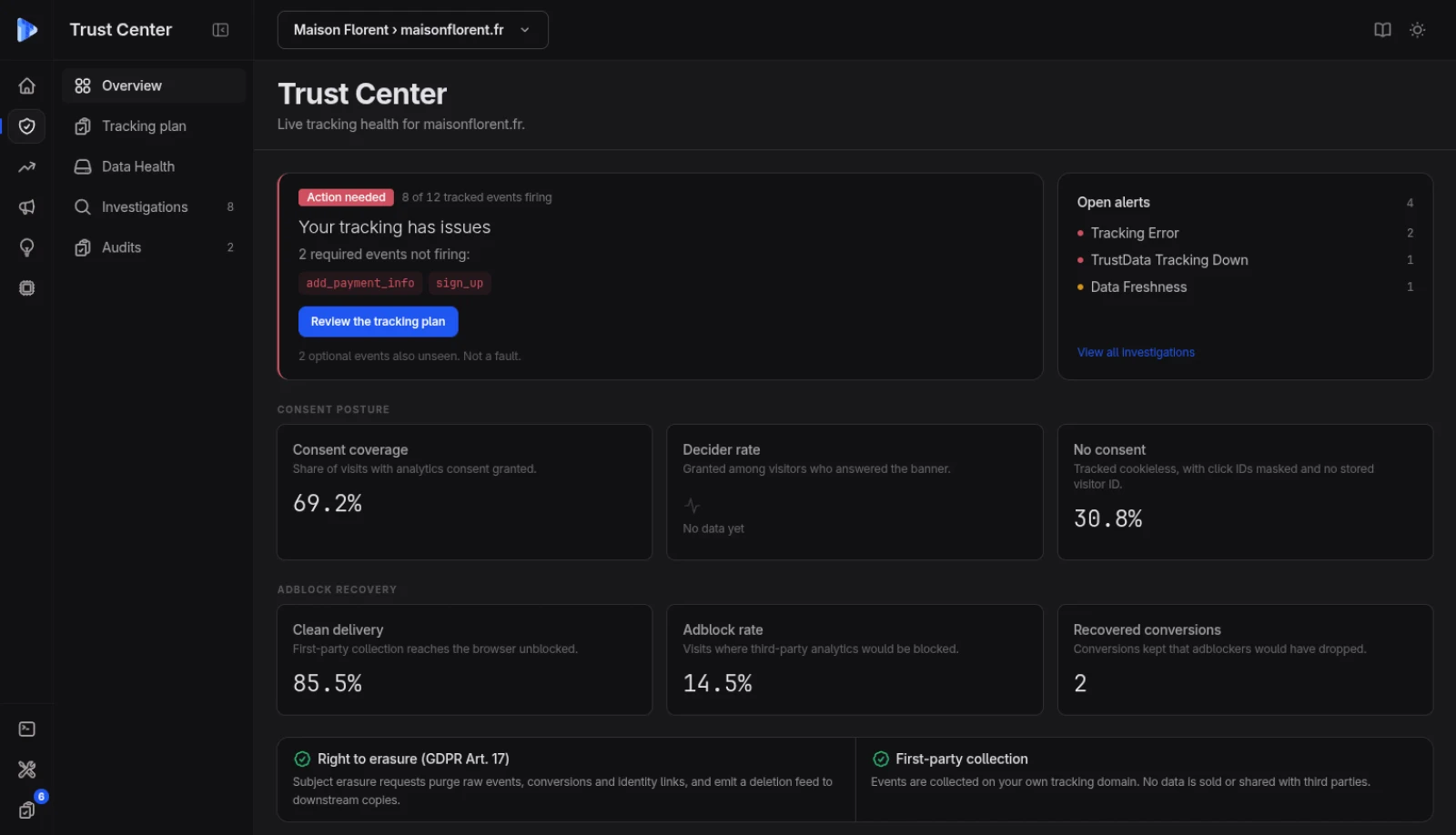
When a client's conversions drop, the investigation runs the checks an analyst would spend an hour on and returns a cause, with a confidence label, in seconds. The audit and the live tracking contract sit underneath, because an AI reading broken data is confidently wrong.
Six checks run at once, from spend to cross-platform reconciliation, and the diagnosis is labelled deterministic, data-backed or contextual.
Unassigned traffic above 10%, a cookie lifetime past the 13 months the CNIL allows, a pixel firing before consent.
Every expected event, the vendor tags wired to it, and a verdict computed when the page is opened rather than stored.
The number
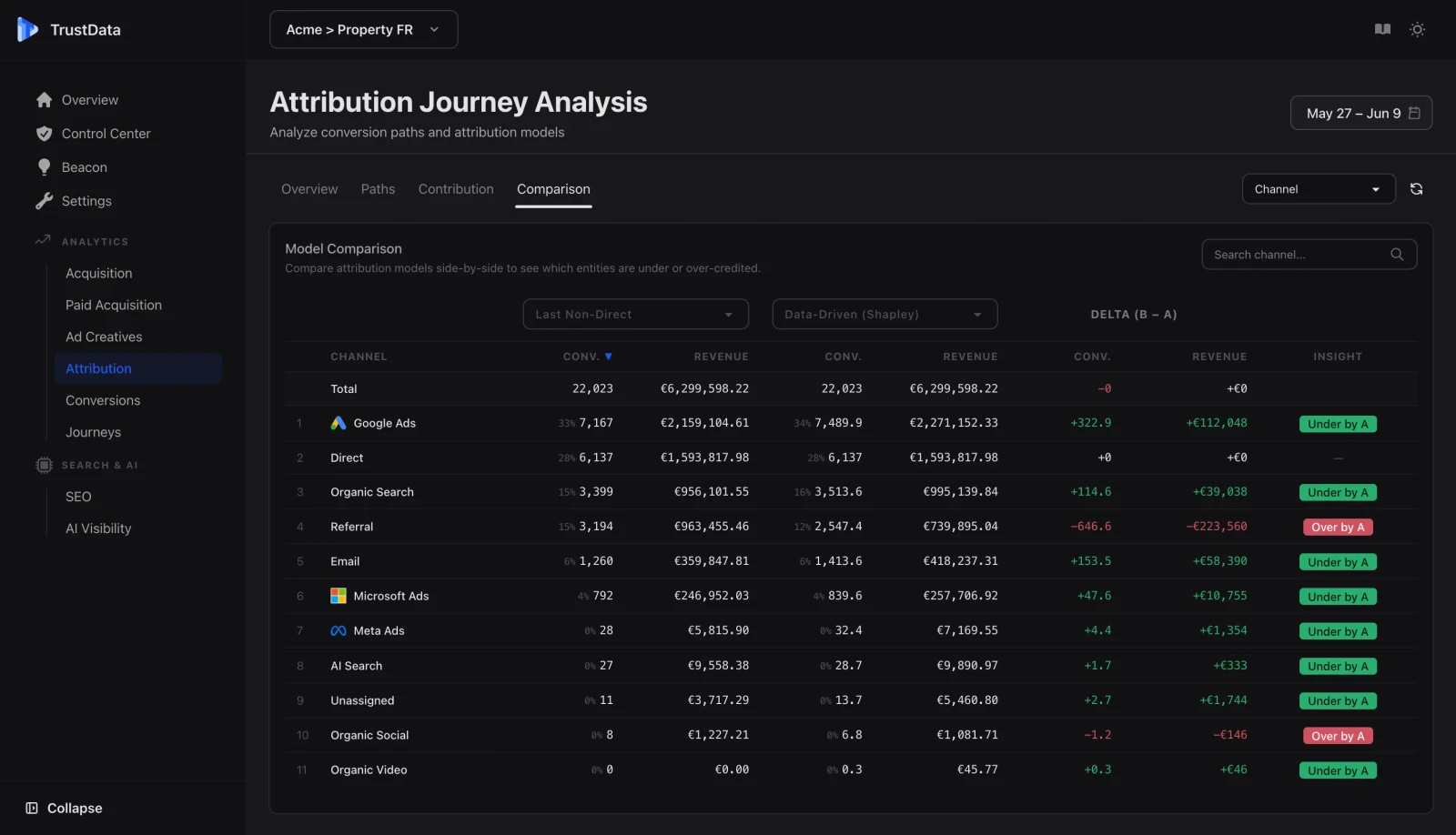
A tracking monitor tells you the pixel fired, not what the client sold. Here every channel reads one deduplicated conversion from the client's store or CRM, with the platform's claim beside it. Claude or ChatGPT read the same tables over MCP, so a client's Meta ROAS is one question away.
Google claims 100, Meta 120, the store recorded 80, and everything starts from the 80, where real ROAS lands 30 to 50% lower.
Claude, ChatGPT or Cursor read the same deduplicated tables over MCP on every tier, and quote the dashboard's number rather than a market average.
Dashboard and report carry your logo, your domain and your colours, and the client never learns which platform is underneath.
Beacon
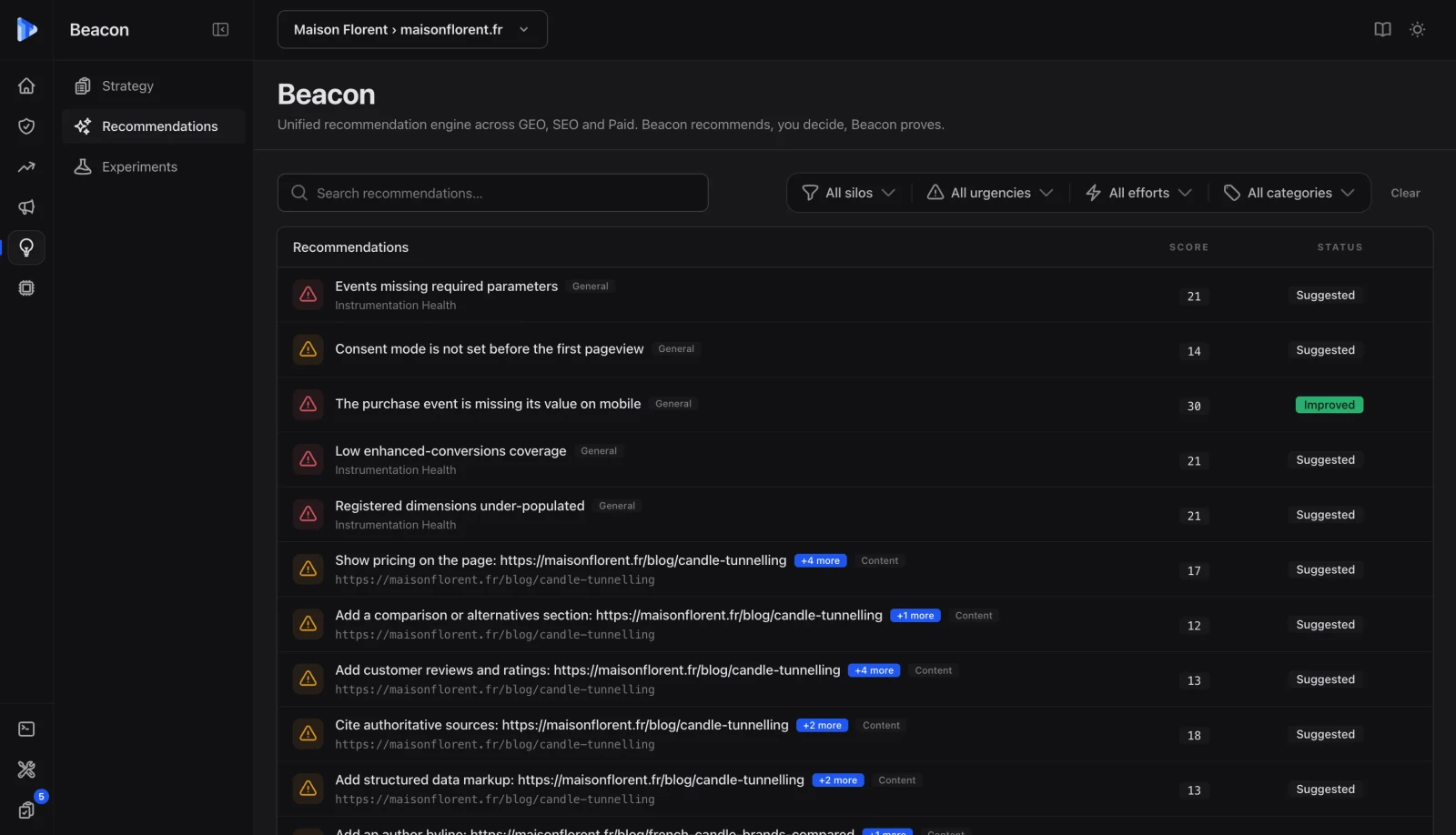
Knowing the true ROAS changes nothing until someone moves a budget. Beacon turns each client's numbers into one queue, a broken tag next to a saturated campaign, sorted on urgency and effort. Every action gets a verdict after 14 days. It never touches the ad accounts. From Optimize.
GEO, SEO, paid and tracking defects compete in one list on urgency and effort, so the account lead works the top of it.
Each action is tracked against the drift of the client's other channels, so a market-wide move does not get counted as your win.
Every rule carries how often it fired, was followed and won, and a rule that keeps losing drops down the ranking.
Pitch Desk
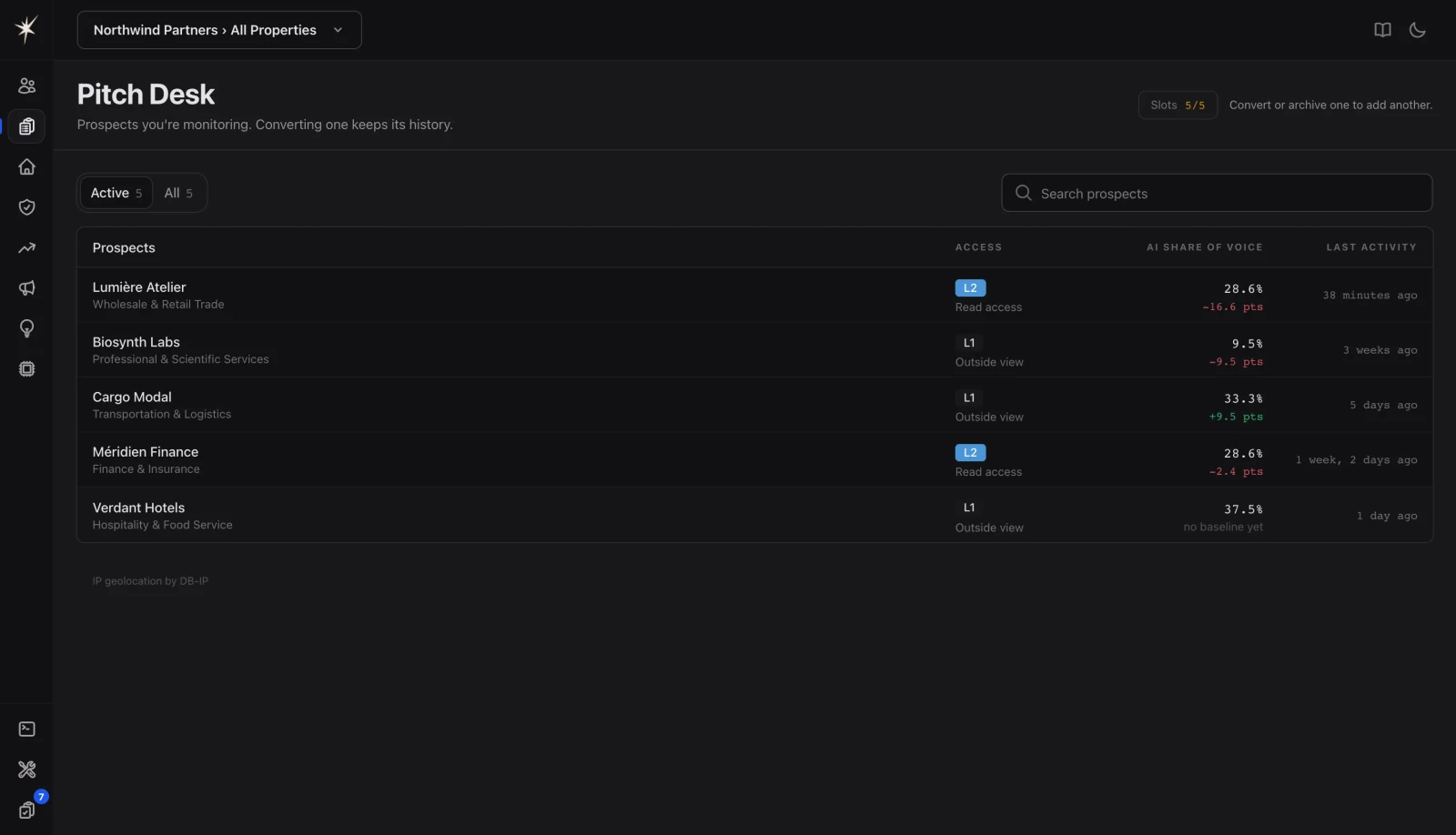
Pitching is where the unpaid hours go, usually on an audit that is stale by the meeting. A prospect workspace keeps it running. Sample row: a prospect at 18% AI share of voice, down 6 points since your first audit, top of the list because it just dropped.
Each carries its AI share of voice and how it moved since your first audit, and the list opens on whoever just dropped.
Weekly probe cadence, capped at five workspaces, pausing itself after 60 days so an abandoned pitch stops costing anything.
A prospect becomes a client account without going through billing first, so the history you built while chasing them never restarts at zero.
Three ways the same month goes wrong, and what each one costs.
A theme update stops the purchase event, nobody notices for three weeks, and the client does, in their own numbers.
Impact · Three weeks of numbers you cannot defend, and a renewal that starts badly
Google and Meta each claim the same sale. The deck shows both totals next to a Shopify figure that matches neither.
Impact · A ROAS 30 to 50% above what the client actually sold
Twenty logins, one spreadsheet to join them, and an hour per alert to find out whether the drop was the pixel or the market.
Impact · Billable hours spent on work nobody will pay for
Watching the pixel is the floor. These are the parts of the book that need the conversion itself.
Orders read from the client's store or CRM feed attribution, the dashboard and the report, so the number is measured rather than inferred.
Data-driven attribution against last-click on the same window, so the client sees what platform bias costs in one dropdown.
ChatGPT and Perplexity are probed on every plan and Google AI Overviews is read per keyword, per client, against their competitors.
FAQ
Per client, with no platform fee: you pay the rate of the tier each client sits on, discounted 10% from your fifth client, 20% from your tenth and 30% from your twentieth. Every connector is included on every tier, so a smaller client is not handicapped on data sources. Each client sits on the plan that fits their stage rather than everyone being dragged to the same one.
A tracking monitor watches the requests your client's site sends and tells you when a pixel breaks, which is useful and is where it stops. TrustData collects the event itself, reads the orders from the client's store, deduplicates and attributes them, forwards them server-side to Google, Meta and TikTok, and audits the tag manager and pages on top. The audit and the tracking contract cover the monitoring job; the ROAS, the attribution and the AI visibility are the parts a monitor cannot see because it never holds the conversion.
A Looker Studio dashboard shows what each platform reports, so Google's 100 conversions sit next to Meta's 120 and Shopify's 80, and your analyst reconciles them by hand before every client call. Here every client's channels read one deduplicated conversion taken from their store, the tracking contract grades itself live so you know the number is intact, and the white-label report is that same number. What you stop doing is the reconciliation, not the dashboard.
Yes. Each client is its own organisation with its own data, its own connectors, its own users and its own billing, and switching between them is a context change rather than a filter applied to a shared pool. That distinction matters the day a client asks whether their competitor is also your client.
Logo, domain and colours across both the dashboard and the reports, so a client logging in sees your brand throughout. Whether a client gets dashboard access at all is your call, set per client. Nothing forces you to expose the platform to a client who only wants the monthly summary.
Their data goes with them if they want it, and being able to say that cleanly is worth more in a pitch than it costs you in churn. Raw events and attribution tables export to a cloud bucket in Parquet or CSV on the schema the interface reads, with no retention limit quietly deleting history first.
14-day free trial
14-day free trial. Portfolio, per-client isolation and white-label reporting are part of the agency plan, priced per client and discounted as the book grows.
White-label reporting and the tracking contract a client can check, for the agency whose analysts rebuild the monthly deck by hand.
Orders read from Shopify, the theme update that breaks checkout tracking, and being compared against Triple Whale rather than Northbeam.
What the tracking audit checks, how an investigation reaches a diagnosis, and why the contract cannot go stale.