Discovery
Find the searches you do not appear on
The keywords in your market where you have no visits yet, found and ranked like the rest.
Key takeaway
A rank tracker shows you where you are. It does not show where your customers search without finding you. TrustData starts from what people search for, then adds your position, the AI answer and what a visit is worth to you.
Discovery
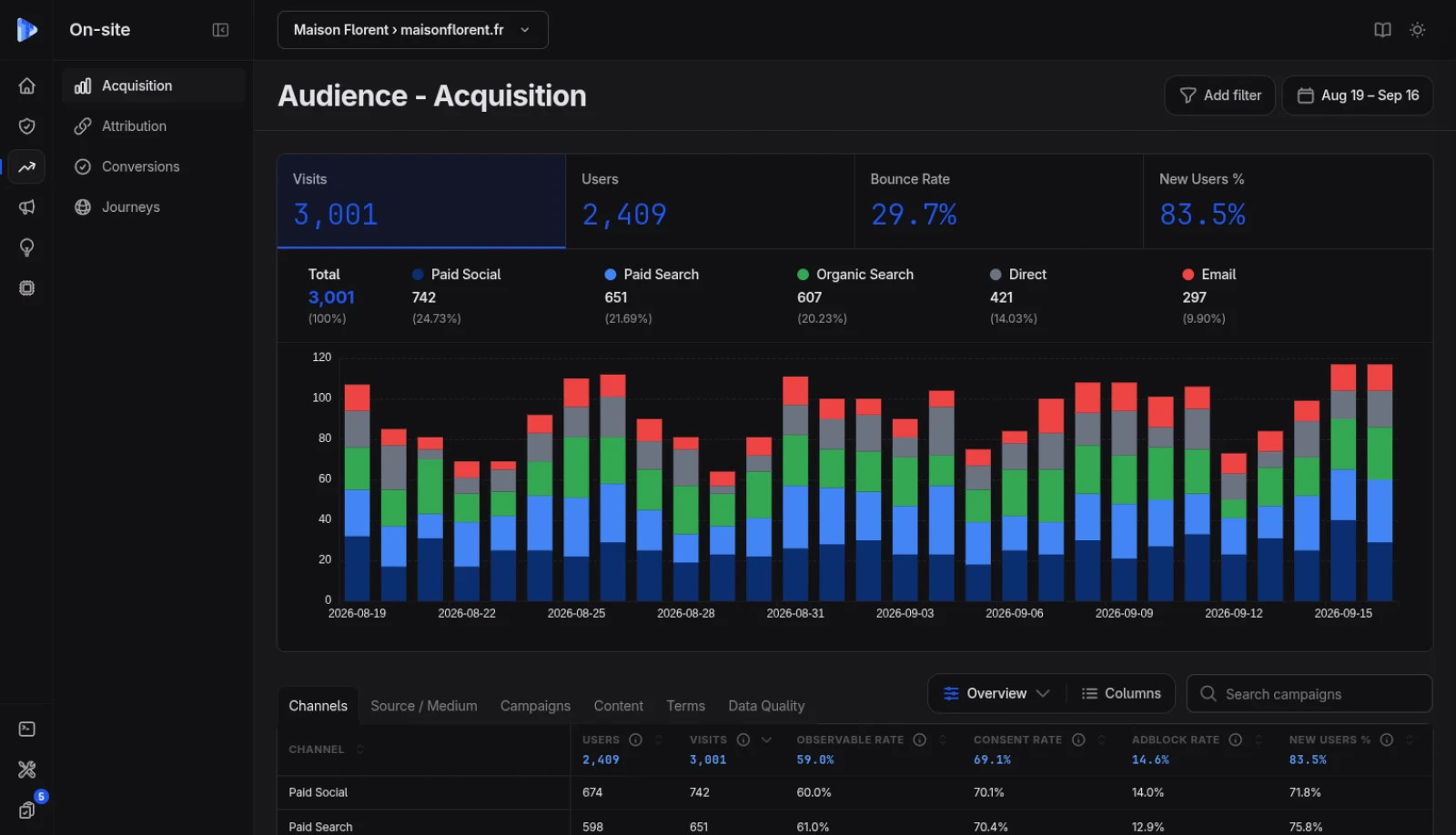
What your customers type into Google is known. What is missing is the list of searches you do not appear on, ranked by what they are worth to you.
The keywords in your market where you have no visits yet, found and ranked like the rest.
Your organic clicks against your market's whole monthly demand, as an order of magnitude, not to the cent.
Every Google volume is checked against a second, independent source, and labelled confirmed, inflated or unconfirmed.
A 0 to 100 score lifts the searches you are absent from and the ones where you are close to the top 3.
The join
For every keyword: your Google position, whether an AI Overview appears and cites you, and whether ChatGPT can find you. A lost link and a won citation read together.
Your keywords are placed by your Google strength and your AI share of voice. Strong on Google, absent from AI: the urgent one.
Over four weeks: how often it appeared, your place among the sources, and the snippet Google takes.
AI Mode is a second Google answer with its own sources. It is tracked separately, never averaged with Overviews.
ChatGPT search goes through Bing. Your Bing indexing therefore becomes an AI visibility signal, tracked here.
Decision
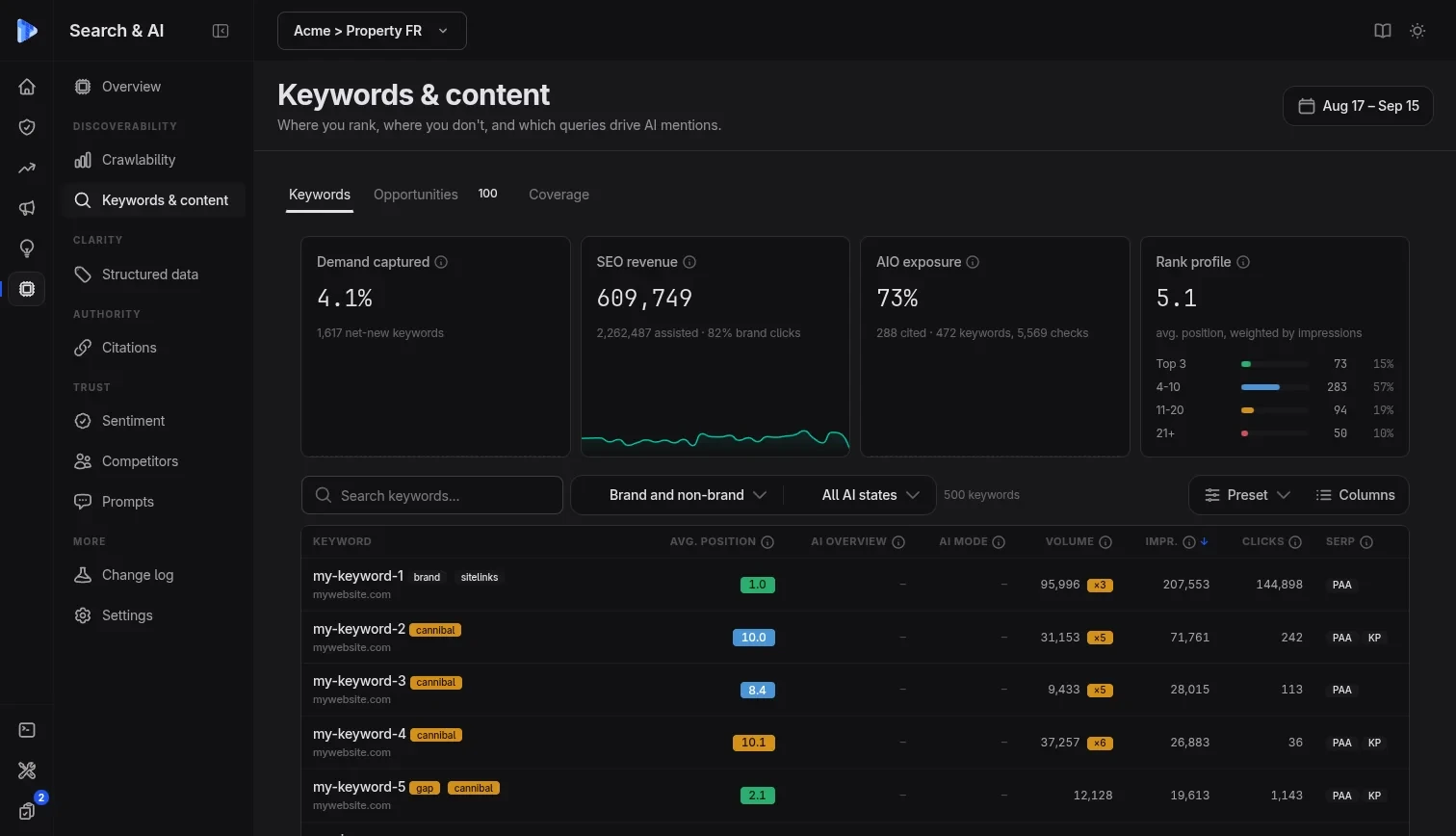
SEO, paid and the visits that come from AI are measured on the same orders. The channels finally compare with each other.
Revenue per organic visit comes from your own sales, not from an industry average.
The same order, from Shopify or your CRM, feeds every channel view and counts once.
Estimated sessions and revenue at top 3 are modelled and the interface says so. We will not dress a projection as proof.
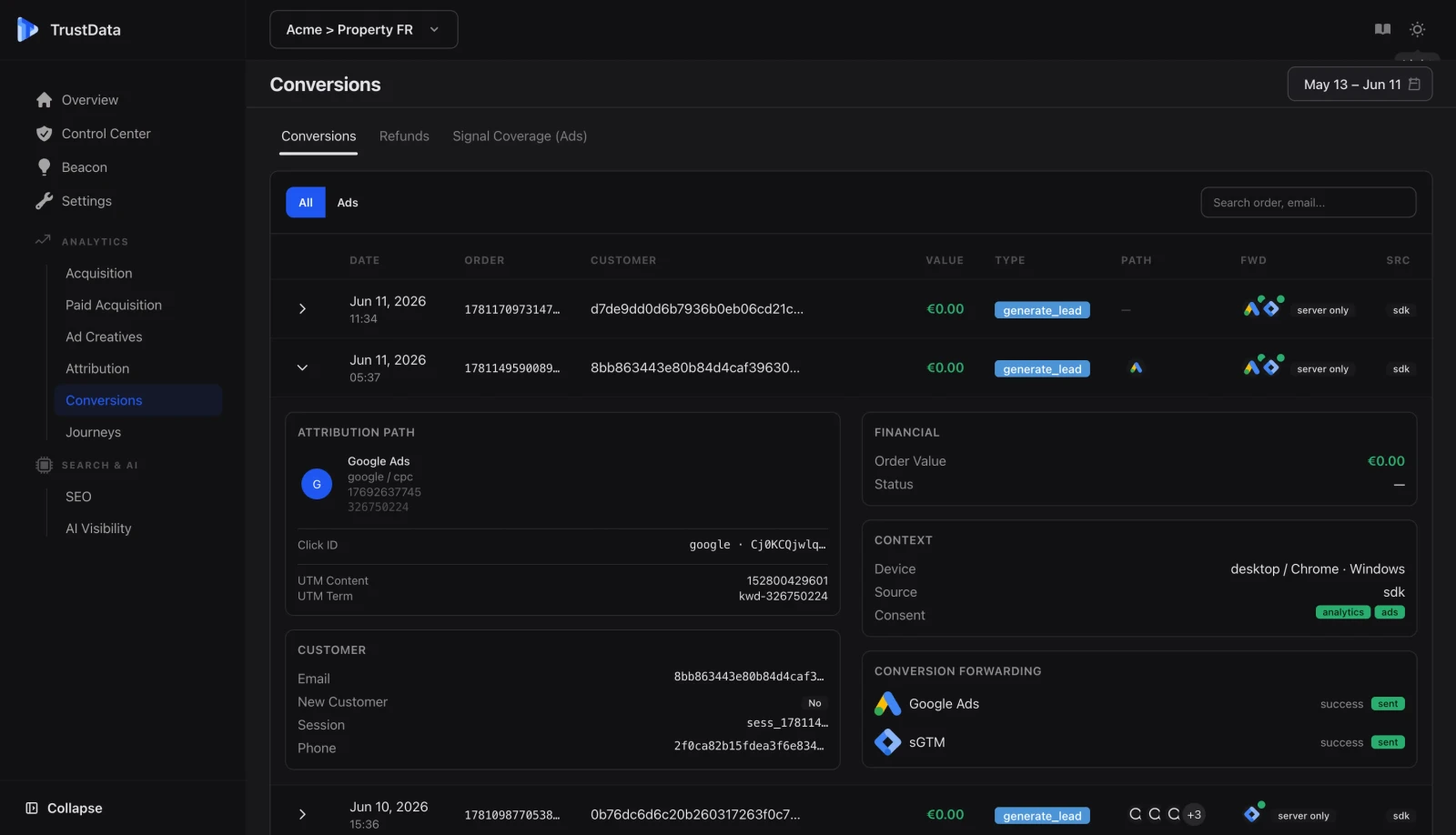
One row per keyword, carrying every surface it appears on. No switching tools to answer the next question.
Average position and deltas with branded and non-branded split, your CTR against the expected rate, and pages competing for one keyword.
Featured snippet, People Also Ask and knowledge panel presence, the top 3 page format, and classified intent with its probability.
Referring domains and domain rank per ranking page. Competitor keywords pool per organisation, from 10,000 on Measure to 150,000 on Prove.
The difference is where the data starts and what it is joined to.
Share of your market's demand, not just your rankings
TrustData
Google Analytics 4
Other tools
RarelySearch volume corroborated by an independent source
TrustData
Yes, with a confidence labelGoogle Analytics 4
Other tools
How often AI Overviews appear
TrustData
Google Analytics 4
Other tools
Yes or no, if at allAI Overviews and AI Mode tracked separately
TrustData
Google Analytics 4
Other tools
Joined to deduplicated first-party conversions
TrustData
Google Analytics 4
PartialOther tools
Cannibalisation and winning page format
TrustData
Google Analytics 4
Other tools
Sometimes| Feature | TrustData | Google Analytics 4 | Other tools |
|---|---|---|---|
| Share of your market's demand, not just your rankings | Rarely | ||
| Search volume corroborated by an independent source | Yes, with a confidence label | ||
| How often AI Overviews appear | Yes or no, if at all | ||
| AI Overviews and AI Mode tracked separately | |||
| Joined to deduplicated first-party conversions | Partial | ||
| Cannibalisation and winning page format | Sometimes |
FAQ
A rank tracker fed by Search Console reports on keywords you already appear for, because that is all Search Console can give it. TrustData starts from Google Keyword Planner's discovery universe, which includes keywords you have never had a single impression on. Those rows are tagged net-new and scored alongside everything else, so the list you work from includes the demand you are currently invisible to. Each source is used for what it is good at: Keyword Planner for demand, independent SERP data for organic difficulty and result-page state, Search Console for your actual position, and your own first-party sessions for what a visit is worth.
0 to 100, from three parts. Demand contributes up to 40 points, scaled so that a keyword at 200,000 searches still separates from one at 20,000 instead of both landing on the same score. Organic ease contributes up to 30, derived from keyword difficulty rather than Keyword Planner competition, which measures ad competition and is a different thing. Stage contributes 30 for a net-new keyword or 20 for one sitting in striking distance at position 4 to 15.
Yes, on the keyword row itself. AI Overview presence is reported as a rolling four-week rate with the number of observations behind it, alongside your position among the sources, your citation rate and the snippet shown. Google AI Mode is tracked as a separate surface with its own references and positions, because the two behave differently. Keeping both on the keyword row is the point: you can see the trade between a blue link you lost and a citation you won, on one row, instead of inferring it across two tools.
You connect three: Google Search Console for your positions, clicks and impressions, Google Keyword Planner for the discovery universe and Google-direct volume, and Bing Webmaster Tools for Bing index state, which matters because Bing is the retrieval layer behind ChatGPT search. Your own first-party tracking supplies sessions, conversions and revenue per organic session. On top of those, TrustData adds keyword difficulty, SERP features, backlinks, AI Overview and AI Mode state, and an independent clickstream volume to check Google's numbers against. All of it is included and none of it is a separate purchase.
Not causally, and we will not present it as though you can. SEO sits in the leading-indicator regime: rankings, citation rate, share of voice, coverage, each reported with its noise level. Estimated sessions and revenue at top 3 are modelled projections, labelled as such in the interface, and they exist to size a bet rather than to close a loop. Causal claims are reserved for paid media, audiences and smart links, where geo, time and platform holdout tests can carry them with explicit confidence intervals. That line is deliberate and we do not cross it.
14-day free trial
14-day free trial. SEO keyword intelligence is included in every plan, from 500 tracked keywords on Measure to 5,000 on Prove.