Locked rungs
Stop optimising a rung you have not earned
If a crawler cannot reach the page its citation rate is noise, so everything above the break stays locked until you clear it.
Key takeaway
A blended visibility score is unactionable by construction: it averages a crawler that cannot reach you with a page an engine cannot extract, and hands you one number for two unrelated problems. The ladder refuses to average. It names the one rung that is broken and locks the ones above it, because fixing rung four while rung one blocks the crawler is wasted work.
The ladder
Every competitor sells a number. A number tells you where you stand and nothing about what to do on Monday. Six rungs run from whether an engine can fetch your page at all through to whether it will recommend you, and the ladder stops at the first one that fails.
If a crawler cannot reach the page its citation rate is noise, so everything above the break stays locked until you clear it.
Crawl access, extractability, citations, sentiment and prompt coverage each link to the page that explains the fix.
Paragraph length, list ratio and heading density are published with a floor and a ceiling, labelled a first pass rather than settled science.
The engines
Most vendors advertise an engine count and let you assume it is all included. Here is the split, stated up front, because you will find it out at the invoice otherwise.
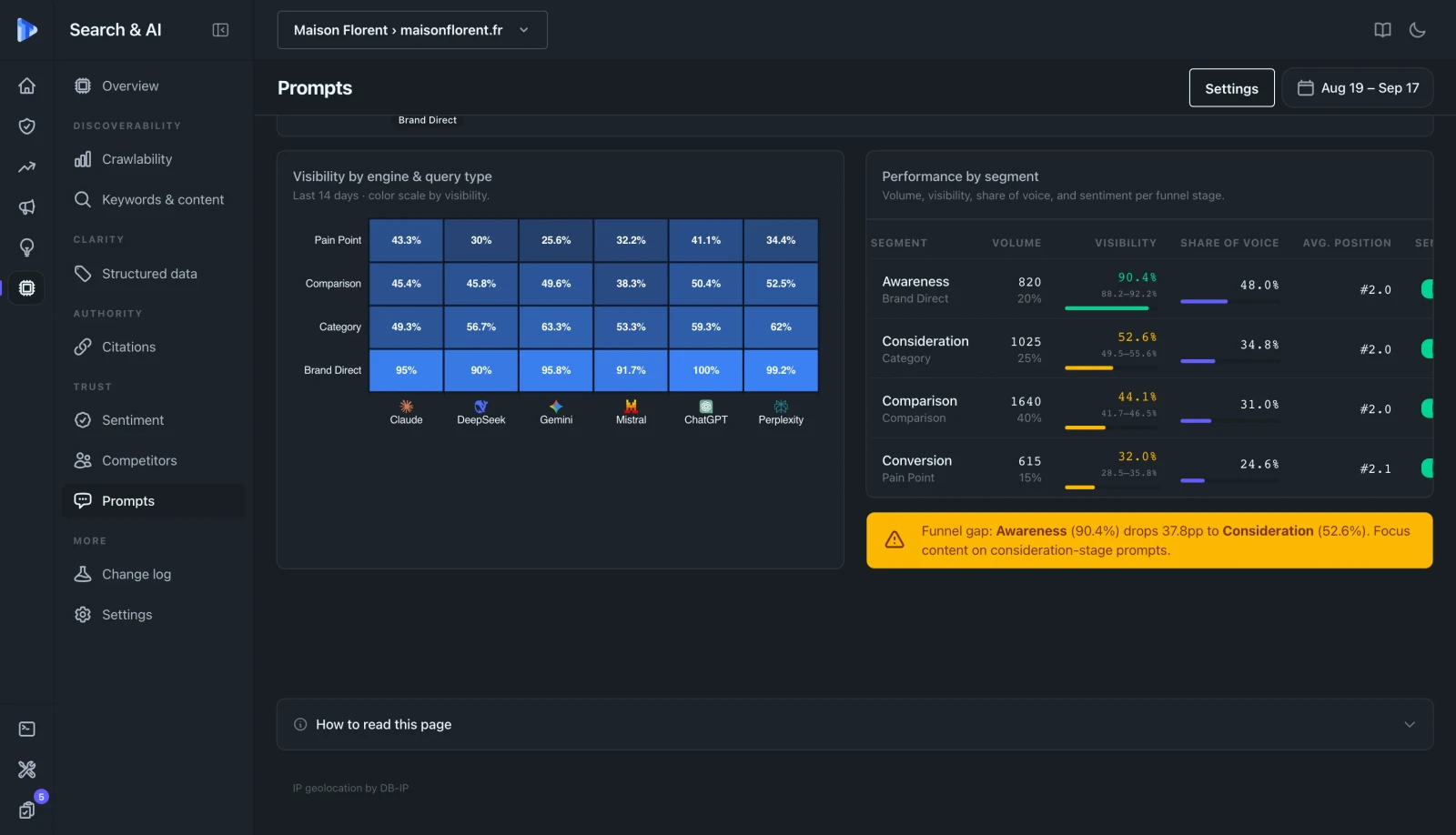
ChatGPT and Perplexity are probed daily, and Google AI Overviews is read per tracked keyword because it is a result page.
Gemini, Claude, Mistral, DeepSeek and Google AI Mode are priced per tier, with AI Mode separate because it behaves and bills differently.
Brand direct, category, comparison and pain point are scored separately, because winning one does not win the others.
The join
AI visibility is a leading indicator. We report it as one and refuse to close the loop we cannot close, which is the part that makes the rest of the numbers worth reading.
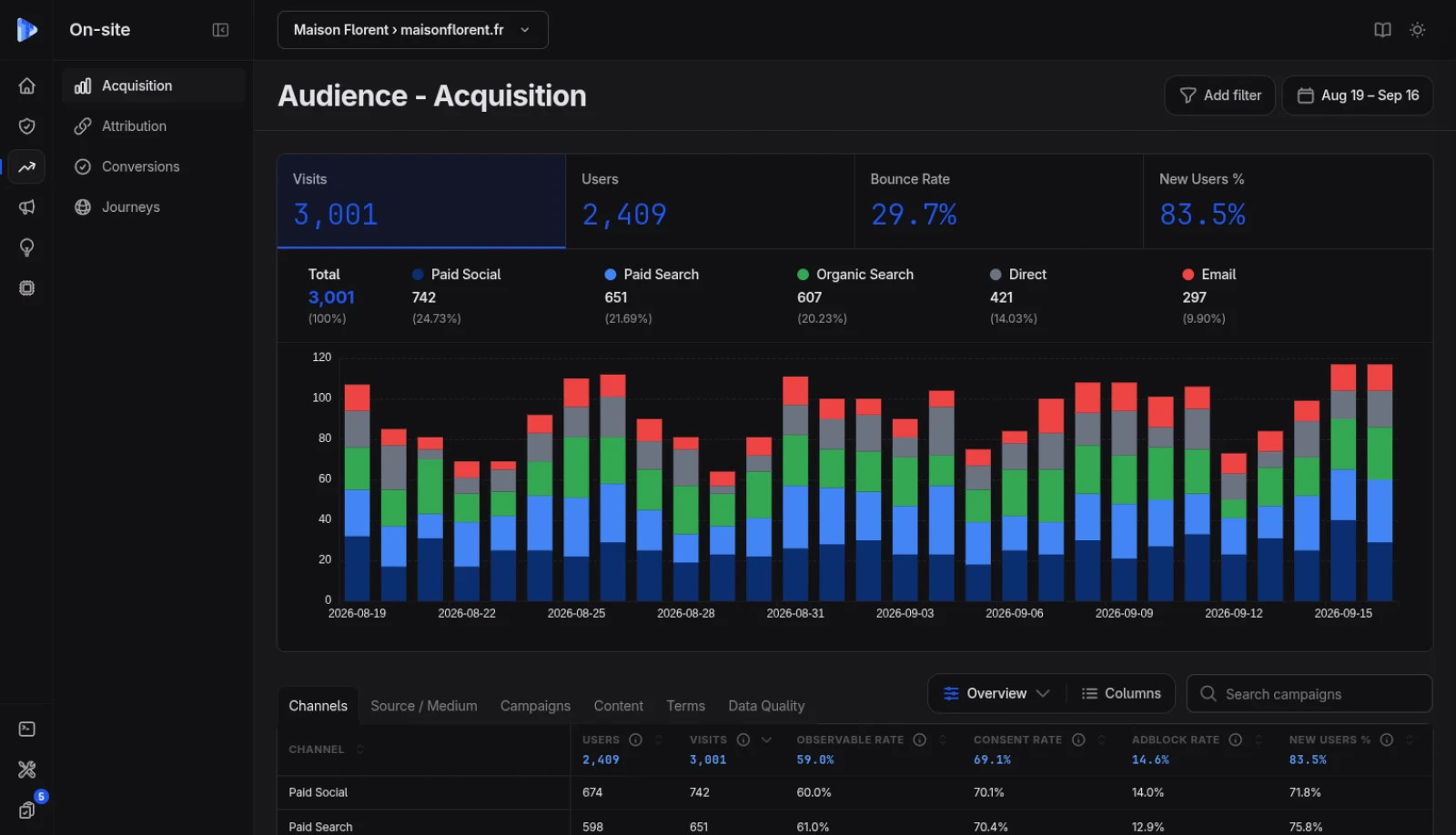
Sessions from AI referrers are identified in your own first-party tracking and measured against the same deduplicated conversions.
Nothing here bridges a citation to an order, because the data cannot carry it. A vendor who bridges it is selling a correlation.
Rankings, AI Overview presence and citation rate sit on one row instead of being inferred across two tools.
FAQ
Because a single score averages problems that have nothing to do with each other. A blocked crawler and a badly structured page both drag a blended number down, and the number cannot tell you which one you have. The ladder refuses to average: it names the first rung that fails, locks everything above it, and links to the fix. That is less flattering than a score out of 100 and considerably more useful on a Monday morning.
ChatGPT and Perplexity are probed daily on every plan, and Google AI Overviews is read per tracked keyword rather than probed, because it is a result-page surface rather than a chat engine. Gemini, Claude, Mistral, DeepSeek and Google AI Mode are per-tier add-ons. We state the split rather than advertising a headline engine count, because the count is what everyone advertises and the split is what you actually buy.
No, and we will not present it as though we can. AI visibility sits in the leading-indicator regime: mention rate, share of voice, citation rate, each reported with its noise level. Sessions from AI referrers are real first-party traffic, measured against your deduplicated conversions like any other channel, so that part is countable. What we refuse to do is attribute an order to a citation. Causal claims are reserved for paid media, where a holdout test can carry them.
A free scan is a snapshot with no history, no competitors and no next step. Running one is a reasonable way to find out whether you have a problem at all. What it cannot tell you is whether last month's fix worked, whether a rival took the ground you lost, or which of six possible causes is yours. If a scan is all you need, take the free one.
Yes. The ladder is the same for any business whose buyers ask questions before they buy. Page audits branch on whether the property is ecommerce or lead generation, so purchase-funnel checks are skipped rather than counted as failures. The revenue join is thinner without orders; the crawl access, extractability, citation and sentiment rungs are unchanged.
14-day free trial
14-day free trial. AI visibility is on every plan, with ChatGPT and Perplexity probed and Google AI Overviews read per keyword.