White-label
Send it under your logo, not ours
Your logo, your domain, your colours, and the client never learns which platform produced the numbers.
Key takeaway
The number in the client's report is the number on your analyst's dashboard, because there is only one. Underneath it sits a tracking contract the client can open and check, with a live verdict.
The report
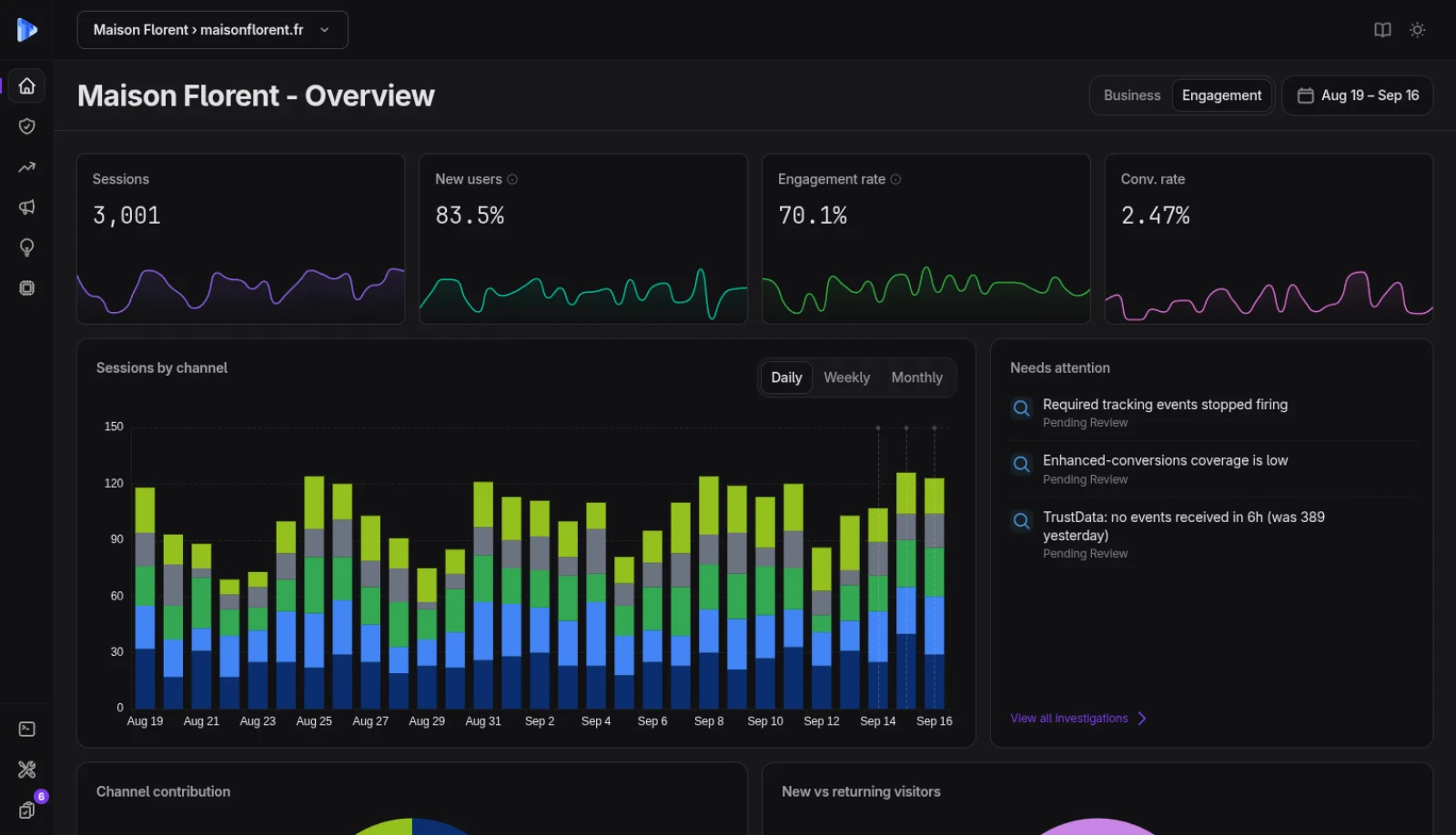
Monthly reporting is the tax an agency pays on every client, and the moment the client decides whether to renew. It cannot be rushed and it cannot be wrong. Here the report reads the numbers your team already trusts, and arrives written.
Your logo, your domain, your colours, and the client never learns which platform produced the numbers.
The report reads the same deduplicated conversion the screen shows, so no slide contradicts what you presented last week.
A weekly summary of what moved and what fired arrives by email, so the deck is written by the time it is due.
The evidence
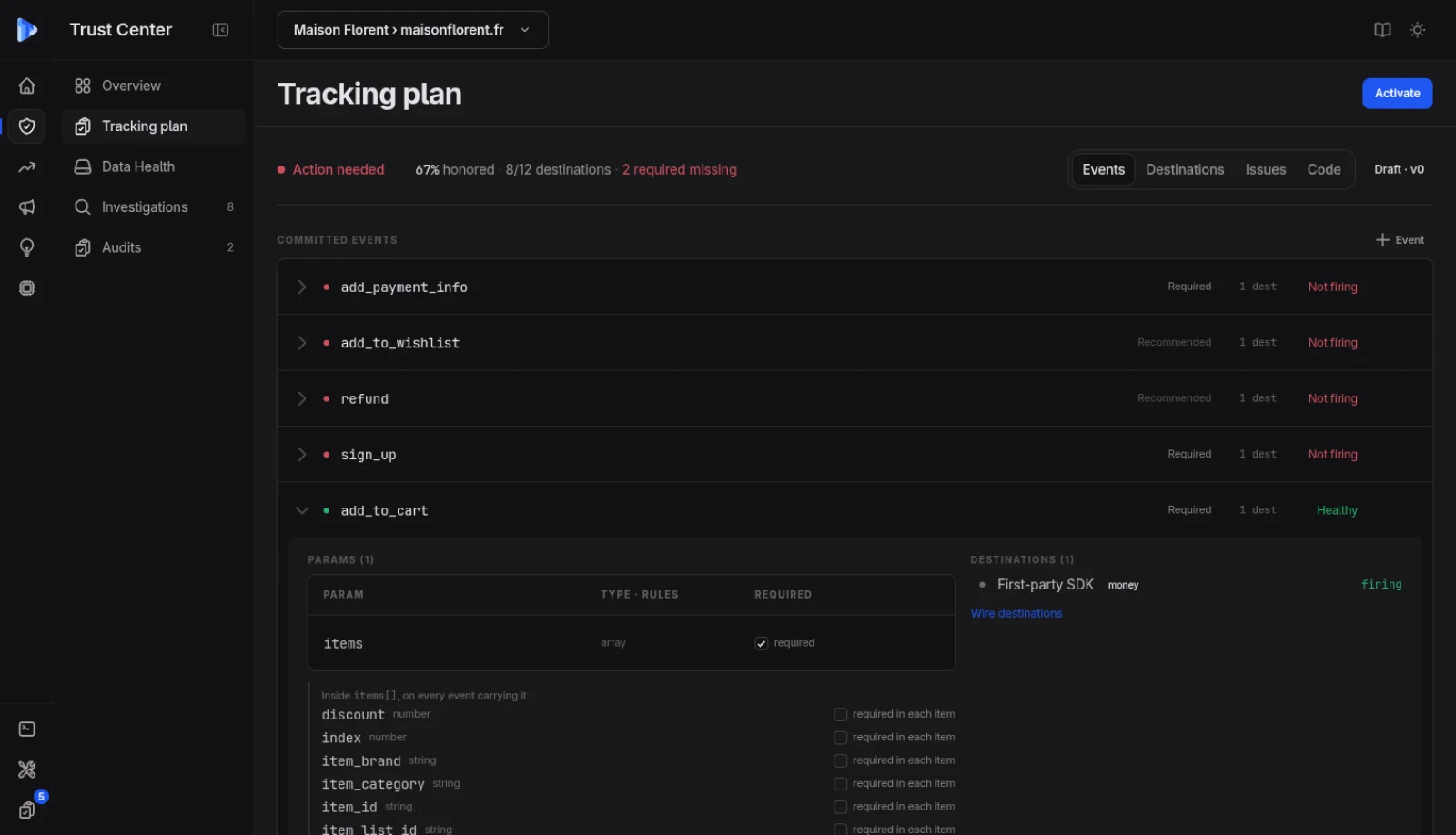
Every agency says tracking is fine. The ones who can prove it renew. The tracking contract lists every event that should fire and the tags wired to it, then grades itself against what happened, with the verdict computed when the client opens the page.
Expected events, the tags that should fire on each, and what is actually observed, in one view the client can check.
You see what the plan said last quarter and who changed it, so the answer is in the document, not someone's memory.
Tag manager config and security, consent and privacy, ecommerce and lead schema, runtime payload, each finding naming its remediation.
The book
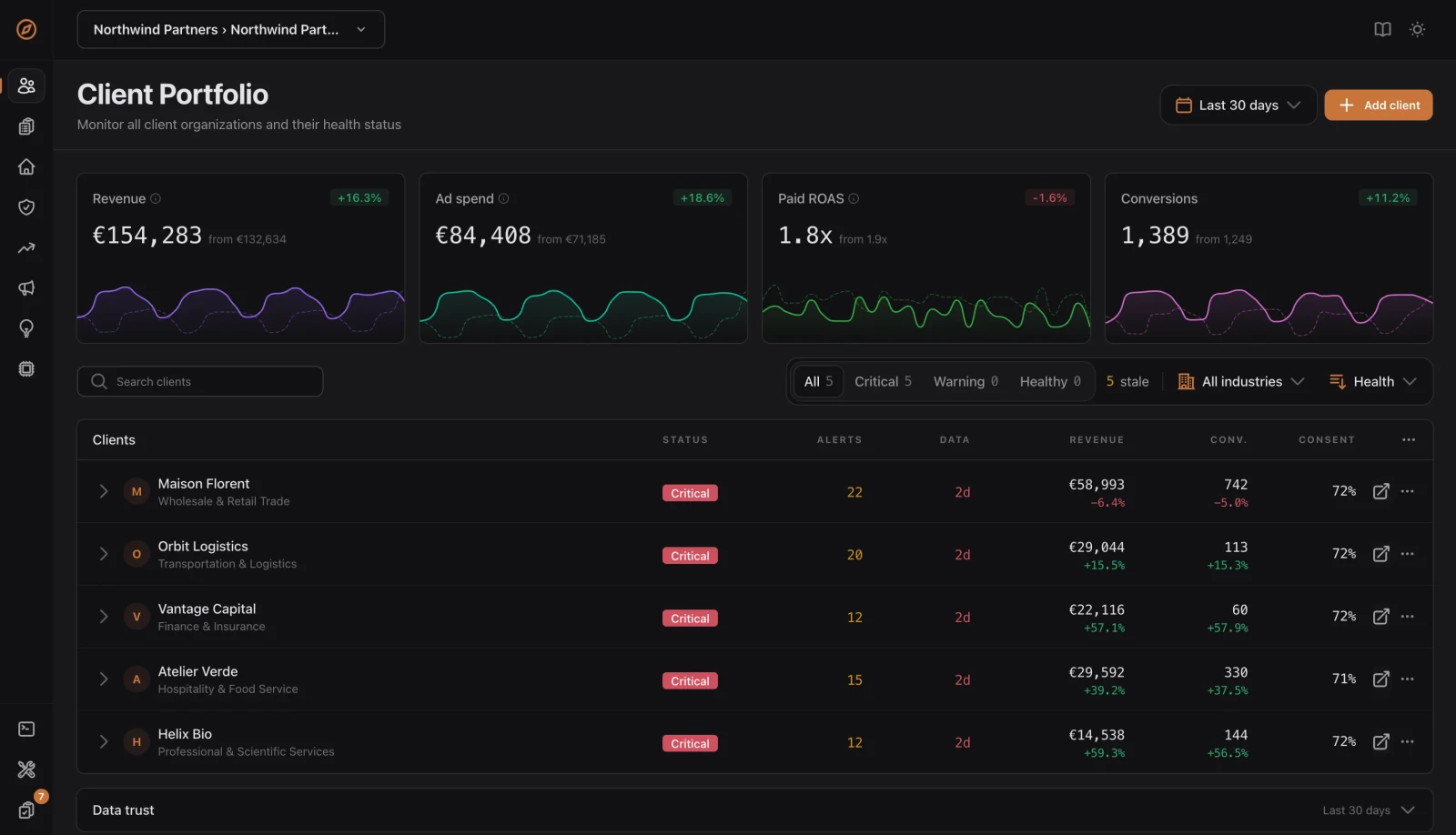
The reporting problem is a portfolio problem. Switching between client accounts, keeping their data apart and knowing which one needs you this week is the work; the deck is where it shows.
Every client from one login, switched in a click, data isolated, access set per client to full, read-only or report-only.
Share of voice and how it moved since your first audit, ranked so the page opens on whoever just dropped.
No platform fee: the per-client rate of their tier, down 10% from your fifth client and 30% from your twentieth.
FAQ
Logo, domain and colours across the dashboard and the reports, so a client logging in sees your brand throughout. Reports can be emailed on a schedule or shared as a link. You decide per client whether they get full dashboard access, read-only access, report-only delivery, or no direct access at all. Nothing forces you to expose the underlying platform to a client who does not need to see it.
A reporting tool visualises whatever you load into it and takes no position on whether the numbers are right, which is why reconciling them is still your job. Here the report is downstream of the measurement: one deduplicated conversion definition feeds the dashboard, the attribution models and the client's deck alike.
That it does not. The report starts from their Shopify orders, so the conversion count matches their store by construction. What differs is the ROAS each ad platform reports, because Google and Meta both claim credit for the same sale and land 30 to 50% above what was sold. The report shows the platform's claim next to the deduplicated number, and the tracking contract shows the events behind it are intact, so the conversation moves from whose figure is right to what to do next.
Yes, and most agencies should. A client who needs clean tracking and honest ROAS does not need the same plan as one running budget experiments. Each client sits on the tier that fits and moves up when they are ready, and the agency plan carries volume discounts by client count. Every connector is included on every tier, so a smaller client is not handicapped on data sources.
The account does, and that is worth saying out loud to a client who asks. Raw events and attribution tables export to a cloud bucket in Parquet or CSV on the same schema the interface reads, with no retention limit deleting history first. An agency that can answer this question cleanly wins engagements against one that cannot.
14-day free trial
14-day free trial. White-label reporting, per-client isolation and the tracking contract are on every plan.