Audit findings
Hand your analyst a defect, not a score
Unassigned traffic above 10%, a cookie lifetime past the 13 months the CNIL allows, a pixel firing before consent.
Key takeaway
Every analytics tool asks you to trust its numbers. This one asks you to check them. The audits, the contract verdict and the investigations all read the same monitor, so the page that grades your tracking cannot disagree with the page that reports your revenue.
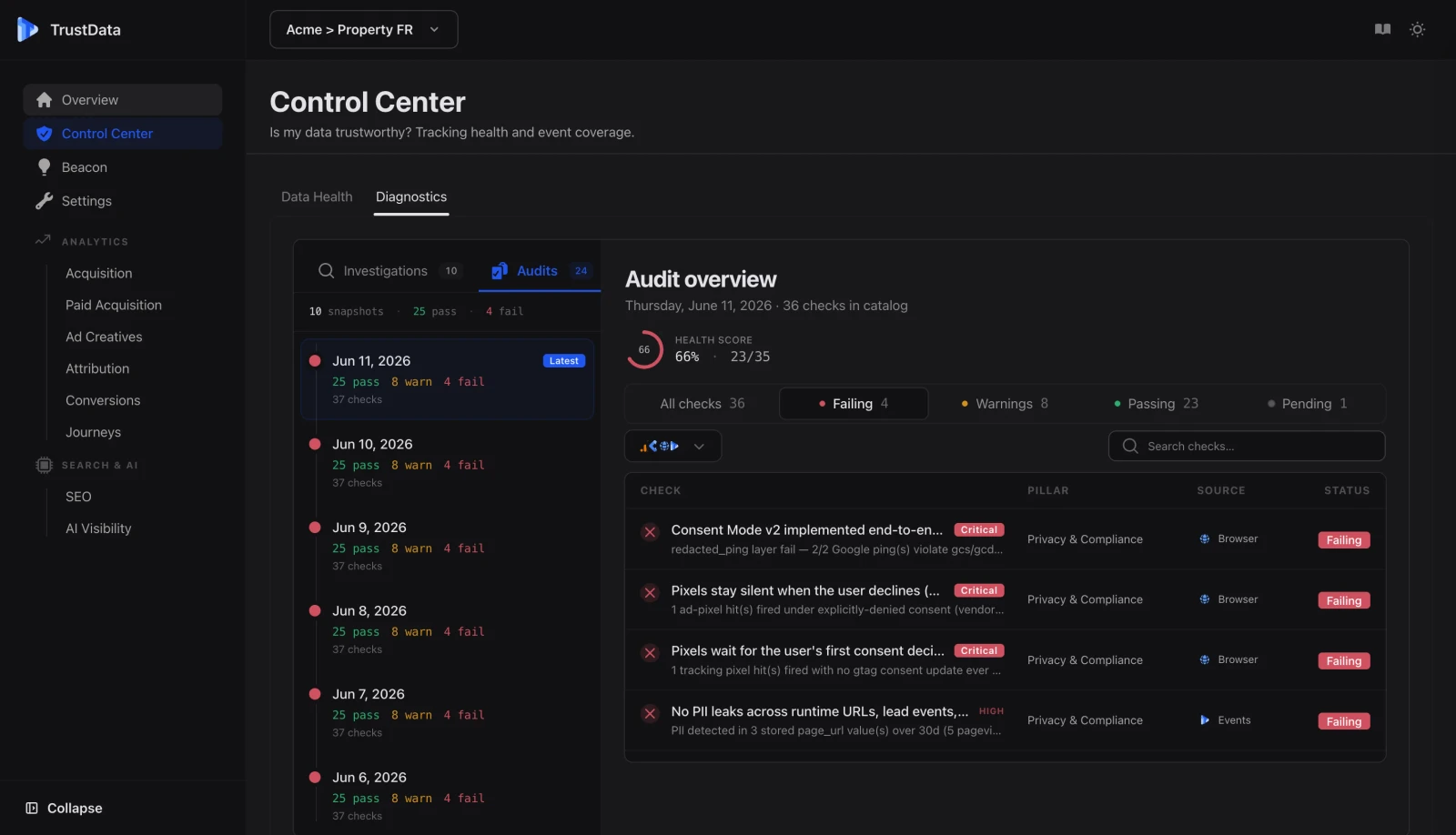
Audits
Most tracking is broken in ways nobody notices for months, because the dashboard keeps drawing a line whatever the line is made of. These checks read your tag manager, your analytics configuration and the pages themselves, and say which specific thing is wrong.
Unassigned traffic above 10%, a cookie lifetime past the 13 months the CNIL allows, a pixel firing before consent.
Your real Google Tag Manager container, your Google Analytics configuration and your own pages.
Checks needing first-party events stay locked until events arrive, instead of failing a property that could never run them.
Ecommerce checks drop entirely on a lead-generation property rather than sitting there as pending.
Contracts
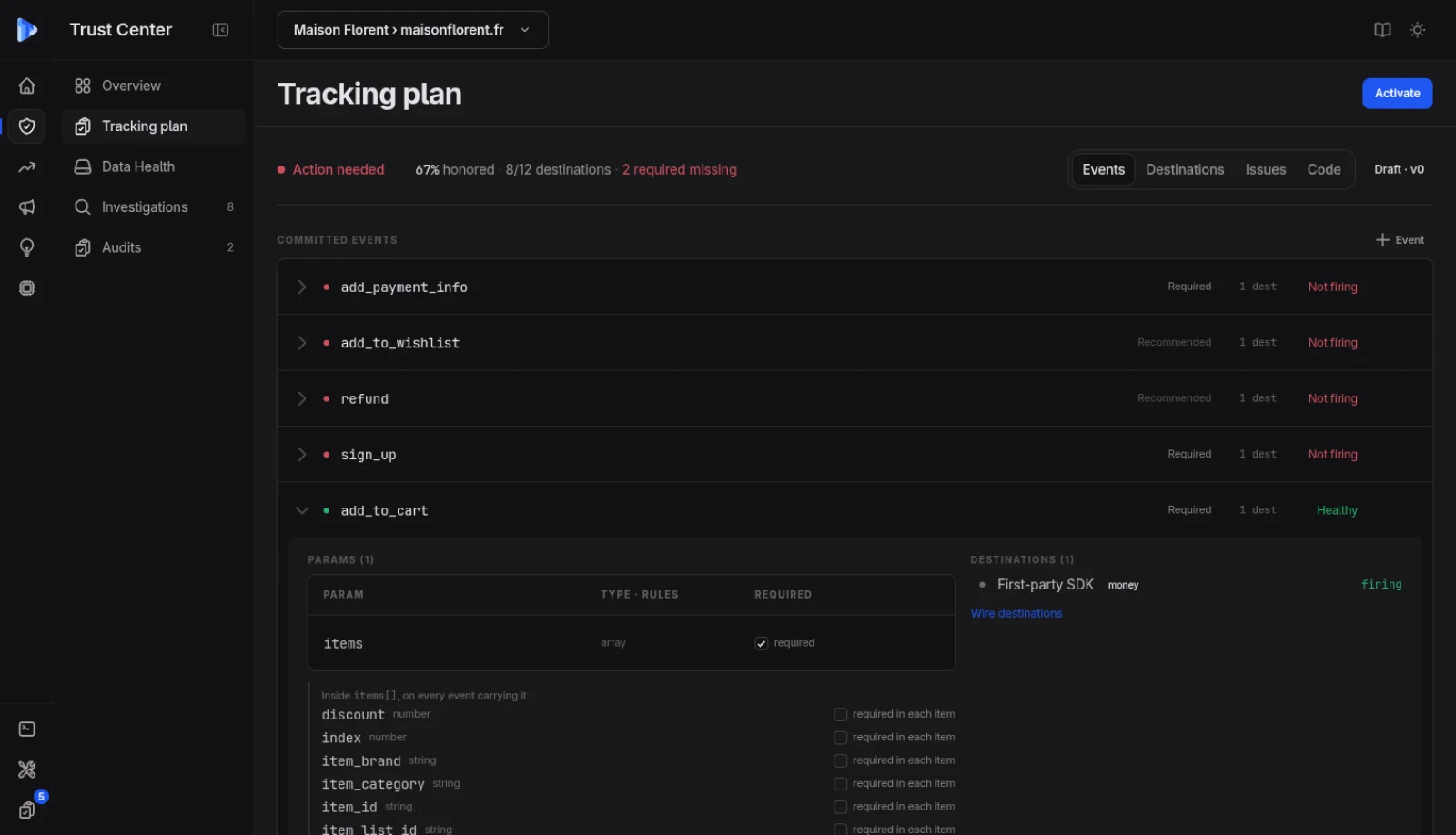
The tracking plan is normally a spreadsheet that was true the week it was written. Here it is a live document: every expected event, the vendor tags wired to it, and a verdict computed at read time from the monitor. It cannot drift from what data health shows, because it reads the same source.
Every expected event, with the tags attached to it.
The verdict is computed when you open the page, so it cannot go stale between you and the truth.
See what the plan said last month, which is what an agency puts in front of a client.
An explorer you swap between TrustData, your analytics and your tags.
Investigations
The 30 to 60 minutes an analyst spends working out why ROAS moved is a checklist, and a checklist is worth automating. What is not worth automating is the decision at the end of it, which is why every verdict comes back to a human.
Every diagnosis is labelled deterministic, data-backed or contextual, rather than blended into one confident paragraph.
Each run records whether a known pattern matched or it fell back to reporting facts.
Name the real cause and the rulebook learns by cause category rather than from free text.
You get extra checks, never a change to your setup.
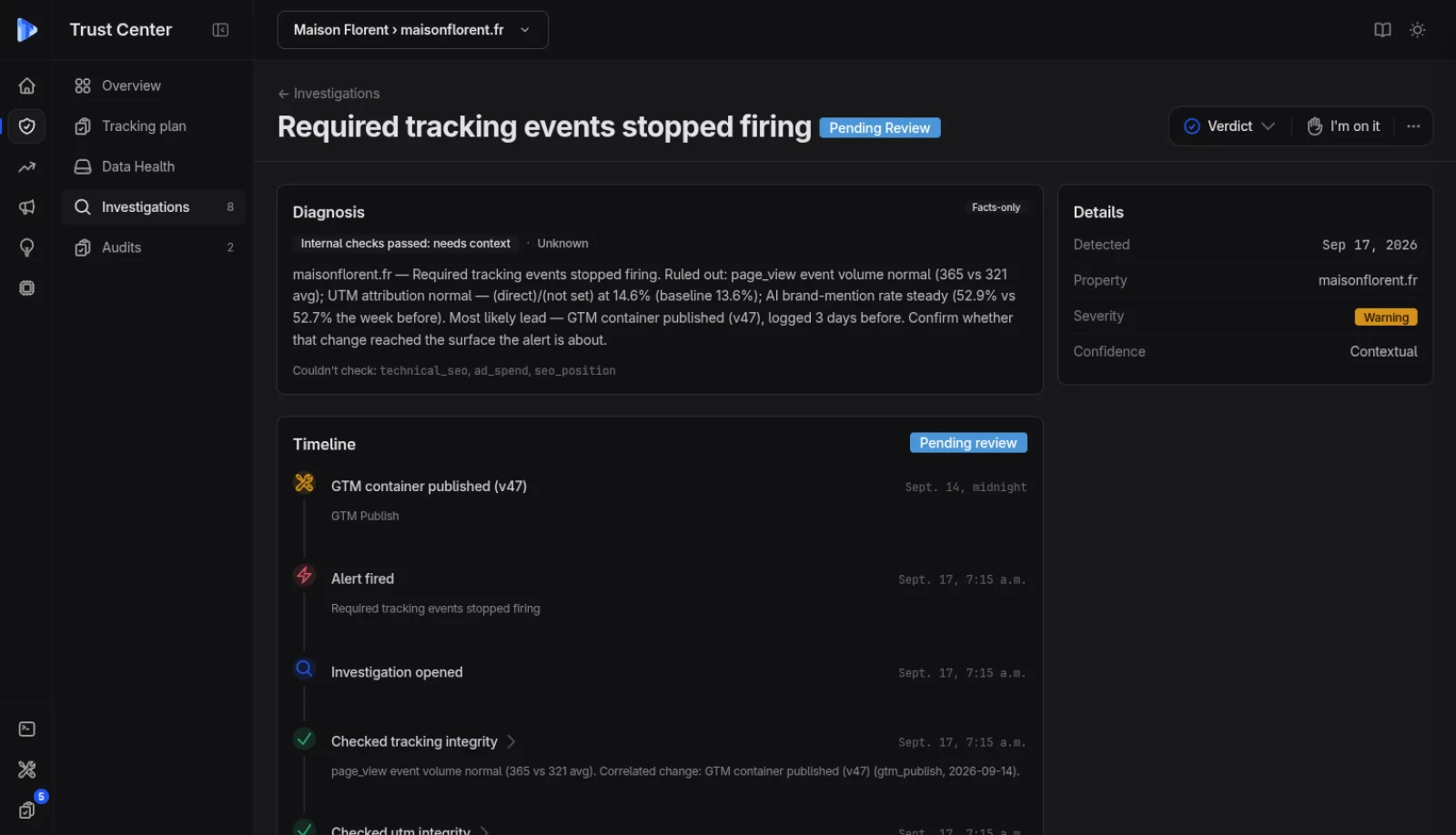
One investigation, as it renders
The alert, what was ruled out, the most likely lead, what could not be checked, and the confidence stated up front. Then your verdict.
Required tracking events stopped firing
page_view volume normal (365 against a 321 average), UTM attribution normal (direct and not set at 14.6% against 13.6%), AI mention rate steady (52.9% against 52.7%).The point of the evidence layer is that it does not end in a report.
A broken tag becomes a ranked recommendation in Beacon's instrumentation silo, with the finding attached as its evidence.
Consent handling, what is collected in each mode, and the governance view over it. Consent is the largest group of checks.
On a rollup lens the signals and the verdict aggregate over every property, so an agency reads one view.
FAQ
The audit runs a fixed catalogue of checks, grouped by category. Tag manager configuration covers duplicate tags, overly broad triggers, whether tags declare their consent requirements, and whether the live container matches the latest version. Tag manager security covers the custom HTML ratio and related exposure. Consent and privacy is the largest group at eight checks. The rest cover ecommerce schema, lead schema and the runtime payload actually sent by your pages. Every check names its remediation and states the customer impact, because a finding without either is a red dot you learn to ignore.
Yes, and it is not sold separately. Lumen was the name for the audits and the anomaly investigations, and both live here as part of Trust Center on every tier. There is no separate line item and no per-property add-on for it. If you saw a price attached to Lumen anywhere, that is out of date and this page is correct.
An alert fires and produces one investigation. It runs a structured set of checks: data integrity first, because a tracking fault makes every downstream number meaningless, then parallel probes over spend, traffic, creative, funnel, campaign labelling and cross-platform reconciliation, then external context. The output is a diagnosis with a cause category and a confidence layer, plus a record of whether a known pattern matched or the run could only report facts. You then record a verdict, and on a wrong or partial one you name the real cause, which is what the rulebook learns from.
It queues. Audits and investigations feed the instrumentation silo in Beacon, so a defect arrives in the same ranked list as your paid and SEO work, with its evidence attached and its lifecycle tracked from planned to done to verified. This is the join worth having: in most stacks the tool that detects the broken tag has no way to make the fix compete for attention against everything else on your plate.
Because an agent cannot tell that a number is wrong. It reads the tables it is given and answers in a confident sentence either way, which makes a tracking defect worse rather than more visible: a wrong number that used to sit in a dashboard nobody opened now gets read aloud in a decision. The audits, the contract verdict and the investigations all read the same monitor as the tables the MCP server hands Claude, ChatGPT or Cursor. So the check that says your tracking is sound and the answer your agent gives are grounded in one source, and when the tracking breaks the verdict changes with it.
That is what it is for. The plan states every expected event and the vendor tags wired to it, the verdict is computed live from the monitor rather than stored, and the revision history shows what was agreed and when it changed. For an agency it is the artifact that turns "tracking is fine" into something a client can check. The client-facing read-only view is a later phase; today the plan, the verdict and the history are all in the product.
14-day free trial
14-day free trial. The audits, the tracking contract and the investigations ship on every tier, including Measure.