Co-citation
See who gets cited alongside you
The domains cited alongside your brand, or instead of it, ranked by frequency and question type.
Key takeaway
When an engine answers a question about your category, it cites a set of sources. The ones that are not yours are not a ranking problem. They are a list of pages to be mentioned on, ordered by how often the engine reaches for them.
Get Cited
Citations are extracted per probe, so every count traces back to a specific answer you can open and read.
The domains cited alongside your brand, or instead of it, ranked by frequency and question type.
Which of your URLs earn citations, on which prompts and engines, with owned flagged separately from earned.
Mentions are counted both ways, because an unlinked one is a reputation signal and a linked one a retrieval signal.
The sources cited on your topics that never cite you, ranked, with every row tracing back to the probes it came from.
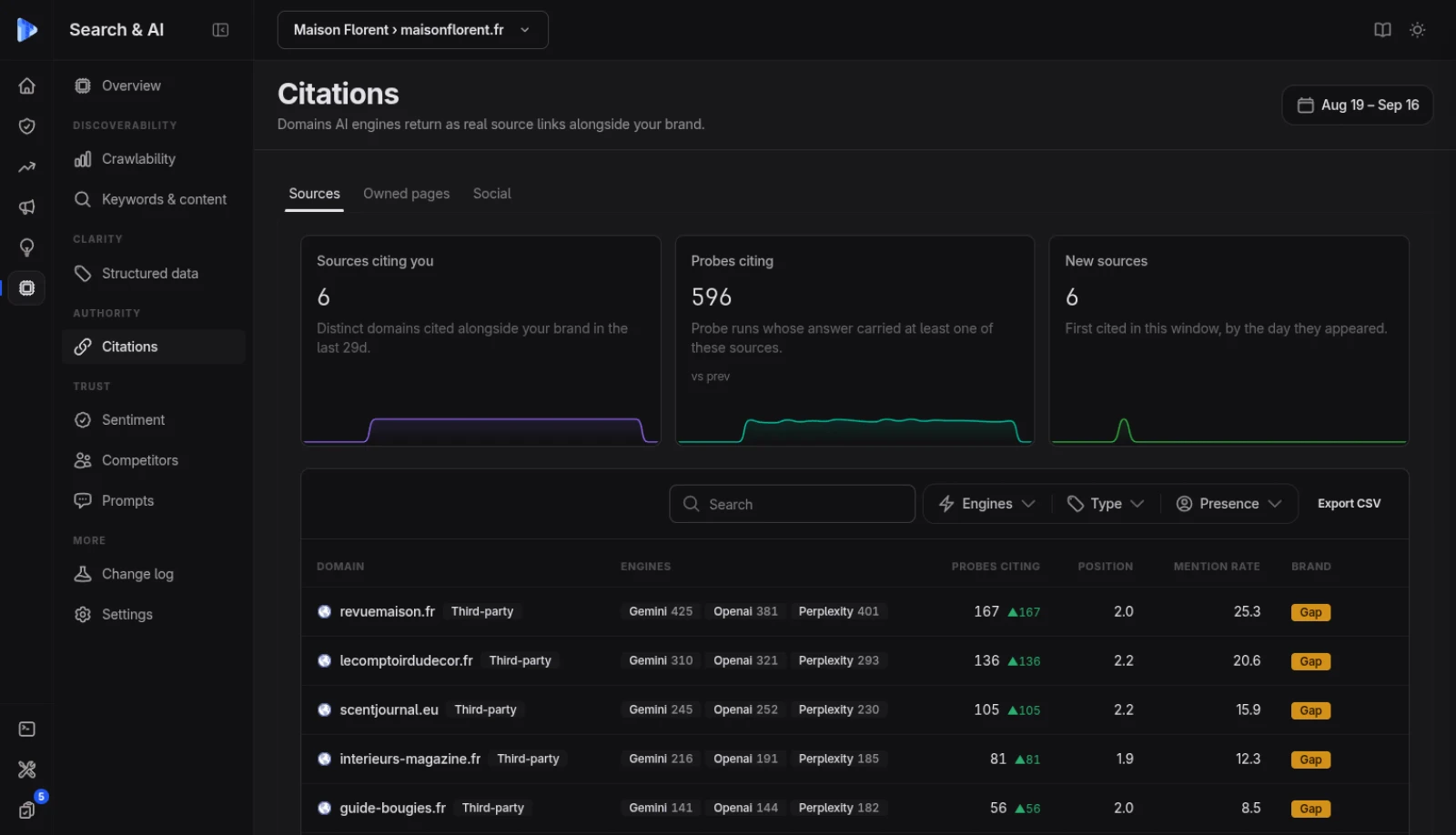
Extracted per probe rather than aggregated up front, so any number on the page can be opened down to the answer that produced it.
The citation array on every probe result is unnested, so a single answer citing eight sources produces eight rows rather than one blended record.
Each citation carries its engine and whether the probe ran with live web search, separating retrieval from training data.
Cited domains are matched against your tracked properties, so owned pages are identified without a list you keep current.
Where your citation sat among the sources. Being the eighth source of eight is not the same result as leading it.
Every citation links back to the prompt that produced it, so you can see which question types earn citations and which never do.
Follow a recommendation and the target URL is watched in later citations. A match alongside a mention-rate lift strengthens a winner.
Citations are where AI visibility stops being about your own site.
Engines cite sources they already trust on a subject, and the co-cited list names exactly which ones count in your category.
A page fetched regularly and never cited has an authority constraint, which is a different quarter's work from a robots fix.
Citation rate ships with its noise level and is never converted into attributed revenue.
Most tools report a mention count and stop there.
Co-cited third-party sources
TrustData
Google Analytics 4
Other tools
SometimesYour own pages cited, separated out
TrustData
Google Analytics 4
Other tools
RarelyLinked against unlinked mentions
TrustData
Google Analytics 4
Other tools
Every citation traceable to a probe
TrustData
Google Analytics 4
Other tools
Citation match after a content change
TrustData
Google Analytics 4
Other tools
| Feature | TrustData | Google Analytics 4 | Other tools |
|---|---|---|---|
| Co-cited third-party sources | Sometimes | ||
| Your own pages cited, separated out | Rarely | ||
| Linked against unlinked mentions | |||
| Every citation traceable to a probe | |||
| Citation match after a content change |
FAQ
AI citation tracking records which URLs an AI engine references when it answers a question. TrustData unnests the citation array on every probe result into one row per cited URL, so a single answer citing eight sources produces eight rows. Each carries the engine, whether the probe ran with live web search, the prompt behind it, and whether the domain is one of yours. That gives two views: the third-party sources cited on your topics, and your own pages that earn citations.
A mention is your brand named in the answer text. A citation is a URL the engine references as a source. You can have either without the other, and they mean different things. An unlinked mention says the model knows you and is willing to name you, which is a reputation signal. A citation says the engine went to a page and used it, which is a retrieval signal. TrustData counts both separately, because a brand with many mentions and no citations has a very different problem from one with the reverse.
Treat it as a ranked outreach brief. The domains on it are the ones an engine already trusts on your subject, and the ones cited most often on your question types are where a placement moves the needle furthest. Because each row traces back to the probes that produced it, you can see which specific questions a source is winning before you approach it, rather than pitching blind from a domain-authority score.
No, and TrustData does not report it that way. Citation rate is a leading indicator, published with its noise level. The sixth rung of the readiness ladder reports AI Search sessions and their conversion rate as proxy signals, labelled emerging. Causal claims are reserved for paid media, where holdout tests can carry them. A tool telling you a ChatGPT citation produced a specific amount of revenue is overstating what the data supports.
Because sources in an AI answer are not equal. Leading the source list for a comparison question is a materially different outcome from being the last of eight, and averaging the two produces a number that describes neither. Position is recorded per citation so that improvement within the source list is visible even in a period where your citation count did not change.
14-day free trial
14-day free trial. Citation tracking is part of AI Visibility, included in every plan.