Per mention
Read how you are framed, not just how often
Every extracted mention is classified and aggregated over a rolling 14-day window, and the positive share scores Be Trusted.
Key takeaway
Mentions are counted linked and unlinked, separately. A brand named often but linked rarely is being discussed rather than recommended, and the two call for different work.
Be Trusted
Classification runs per mention, not per page or per brand, so the unit of analysis is the sentence an engine actually produced.
Every extracted mention is classified and aggregated over a rolling 14-day window, and the positive share scores Be Trusted.
A brand can read positively on brand-direct questions and negatively on comparison ones, so aggregating the two hides the problem.
An unlinked mention says the model holds an opinion of you, a linked one that it read a page. The two are counted apart.
Each classification traces to the probe that produced it, because a sentiment number nobody can audit is one nobody should act on.
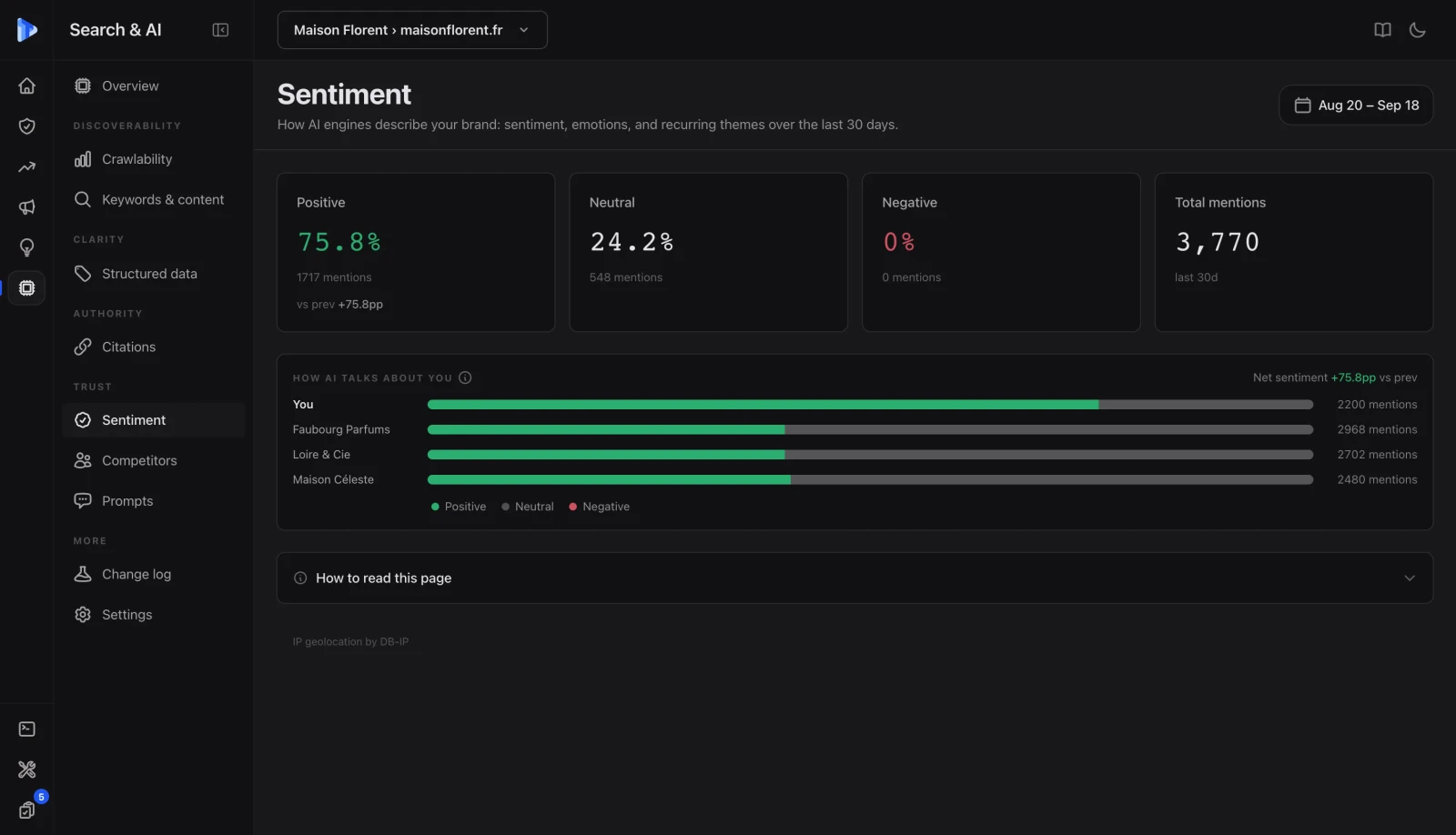
The aggregate is daily, the classification is per mention, and both are inspectable.
Long enough to smooth one unusual answer, short enough that a real change in framing shows within a fortnight.
Total probes, probes where the brand was mentioned, and the sentiment split within those, on one row.
Where your brand appeared in the response. First recommendation and grudging final mention are both mentions, and averaging them describes neither.
The same classification applied to named competitors, so how you are described is read against them on the same questions.
The positive share of brand mentions scores rung 4. Above Be Retrieved, because framing only matters once a page is extractable.
Below the minimum probe count no score is published. Four mentions make a percentage, not a trend.
The two metrics fail in opposite directions, and a combined score hides both.
Being named often as the wrong choice is worse than absence: the engine steers buyers away with a reason you can read.
Negative framing usually traces to a comparison page, review site or forum thread the engine keeps reaching for. The co-cited list names it.
Sentiment is published with its noise level and never converted into revenue, alongside citation rate and share of voice.
Most AI visibility tools report presence and stop.
Sentiment classified per mention
TrustData
Google Analytics 4
Other tools
SometimesSplit by engine and question type
TrustData
Google Analytics 4
Other tools
Linked and unlinked mentions counted apart
TrustData
Google Analytics 4
Other tools
Competitor sentiment on the same questions
TrustData
Google Analytics 4
Other tools
RarelyEvery classification traceable to a probe
TrustData
Google Analytics 4
Other tools
| Feature | TrustData | Google Analytics 4 | Other tools |
|---|---|---|---|
| Sentiment classified per mention | Sometimes | ||
| Split by engine and question type | |||
| Linked and unlinked mentions counted apart | |||
| Competitor sentiment on the same questions | Rarely | ||
| Every classification traceable to a probe |
FAQ
Each extracted brand mention is classified positive, neutral or negative and aggregated over a rolling 14-day window. Classification happens per mention rather than per response, so an answer that recommends you for one use case and warns against you for another produces two classifications rather than one averaged verdict. Every classification links back to the probe and the response text behind it.
Because the engine is not merely failing to recommend you, it is actively steering buyers away and giving them a reason. That reason is usually specific, repeatable and readable in the responses: price, support, a missing integration, a comparison that lands badly. Absence is a discovery problem you fix with content and authority. Negative framing at volume is a positioning problem, and it will not improve by publishing more.
Because the pattern is where the information is. Positive on brand-direct questions and negative on comparison questions is the signature of a competitor whose framing is winning the head-to-head, which is a different fix from being framed badly everywhere. Aggregating the two produces a middling number that describes neither and points at nothing.
A linked mention comes with a citation to a URL; an unlinked one is your brand named in the text with no source attached. Unlinked mentions indicate the model holds an opinion about you from its training data. Linked mentions indicate it went and read something. They move for different reasons: unlinked shifts with model refreshes you do not control, linked shifts with content and authority work you do.
Not causally, and TrustData will not present it that way. Sentiment sits in the leading-indicator regime with citation rate and share of voice, reported with an explicit noise level. The sixth rung reports AI Search sessions and their conversion rate as proxy signals, labelled emerging. Causal claims are reserved for paid media, audiences and smart links, where geo, time and platform holdout tests can carry them with confidence intervals.
14-day free trial
14-day free trial. Sentiment tracking is part of AI Visibility, included in every plan.