ICP prompts
Skip inventing a prompt list from scratch
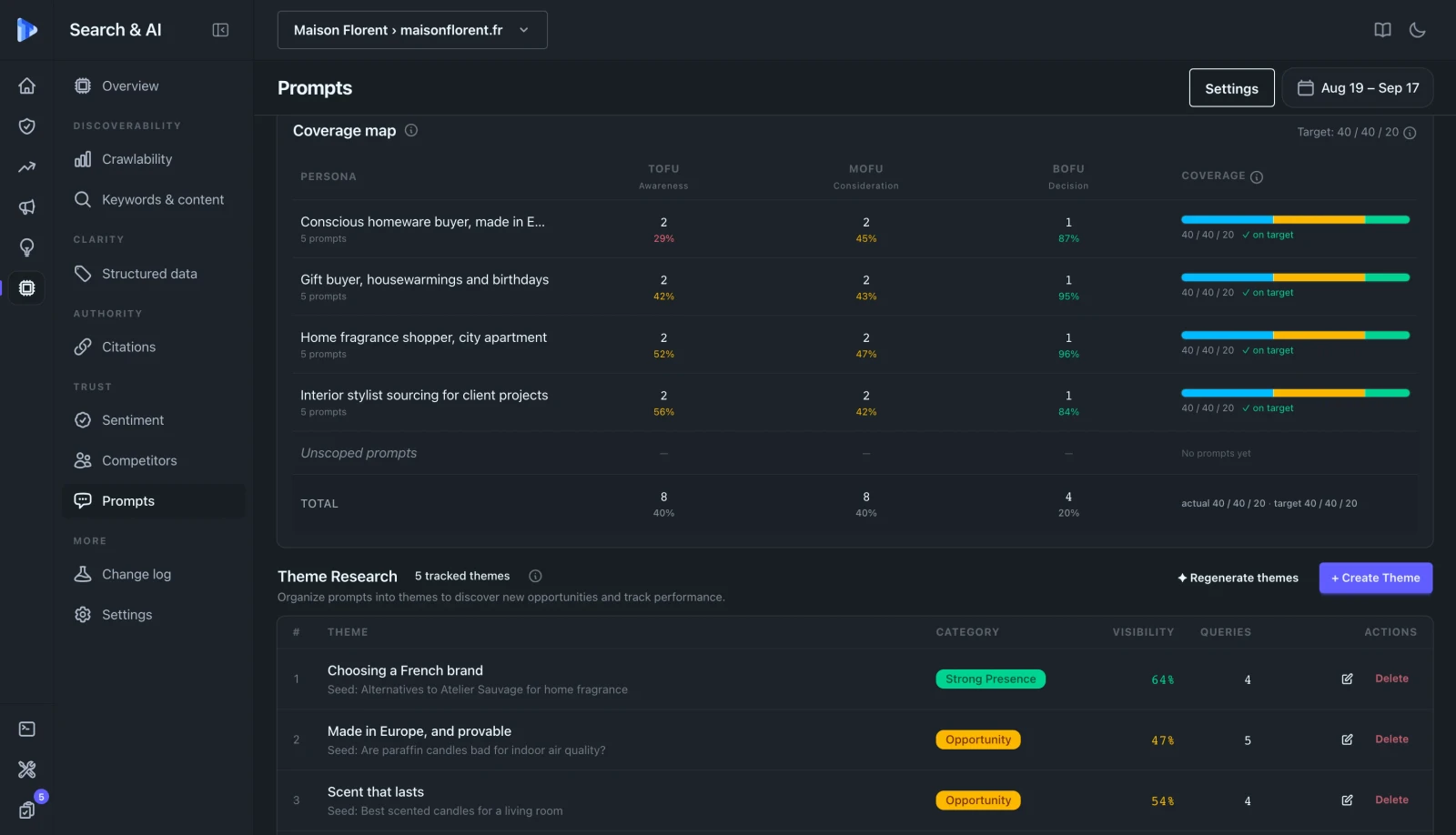
Define your audience once and prompts are generated from those personas and observed search demand, then suggested in bulk to edit or reject.
Key takeaway
A prompt's stability is the median pairwise similarity of the brand lists returned across its recent probes. Below the floor, the prompt is flagged rather than charted, because a line drawn through noise looks exactly like a line drawn through a result.
Coverage
Guessing at prompts produces a list that flatters the brand. These come from your audience and from real demand.
Define your audience once and prompts are generated from those personas and observed search demand, then suggested in bulk to edit or reject.
Brand direct, category, comparison and pain point map to different buying stages, fail differently, and are scored separately.
The median pairwise similarity of the brand lists returned across recent probes, so a low score means any trend drawn from it is noise.
0 to 1 across four axes: how well it discriminates you from competitors, mention-rate stability, decision linkage and probe freshness.
Every number on a prompt traces to the probes behind it, and the responses are kept.
Each prompt runs with live web search and without. The gap separates what the model knows from what it just read.
The answer behind every result is stored and readable. A mention rate you cannot open is a number you have to take on faith.
Mention rate, position and sentiment over time per prompt, so a fall in the aggregate traces to the questions that moved.
50 monitored prompts on Measure through 400 on Prove, against monthly probe budgets of 3,000 to 24,000, capped rather than billed past.
Prompts can be prioritised, paused and edited in bulk, because a prompt set is a living list rather than a one-time setup step.
Brand mention rate across the prompt set scores rung 5, with the AI Overview gap count surfaced alongside it as evidence.
It is the metric that decides whether the rest of the numbers mean anything.
A prompt with a low reproducibility score moves persuasively and means nothing. Publishing it beside the trend is the whole difference.
We claim persona-grounded prompts return more stable brand lists than invented ones. Reproducibility proves or disproves it on your data.
Chasing a mention-rate dip on an unstable prompt costs a sprint and produces nothing, because the dip was never there.
The difference is where the prompts come from and whether their stability is known.
Prompts generated from ICP and real demand
TrustData
Google Analytics 4
Other tools
Manual entryReproducibility score per prompt
TrustData
Google Analytics 4
Other tools
Quality score across four axes
TrustData
Google Analytics 4
Other tools
With-search and no-search on the same schedule
TrustData
Google Analytics 4
Other tools
RarelyFull response retained and readable
TrustData
Google Analytics 4
Other tools
Sometimes| Feature | TrustData | Google Analytics 4 | Other tools |
|---|---|---|---|
| Prompts generated from ICP and real demand | Manual entry | ||
| Reproducibility score per prompt | |||
| Quality score across four axes | |||
| With-search and no-search on the same schedule | Rarely | ||
| Full response retained and readable | Sometimes |
FAQ
It is the practice of running a fixed set of questions against AI engines on a schedule and recording how your brand appears in the answers. TrustData runs each prompt in two modes, with live web search and without, across four question types, and keeps the full response behind every result. Prompt counts run from 50 on Measure to 400 on Prove, against monthly probe budgets of 3,000 to 24,000.
It is the median pairwise similarity between the brand lists an engine returned across a prompt's recent probes. If an engine returns roughly the same set of brands each time, the prompt is stable and a trend drawn from it means something. If the set changes every run, the prompt is unstable and its chart is noise that will still look like a trend. Publishing the score next to the trend is what stops a team spending a quarter chasing a movement that was never real.
From your own audience definition and from observed search demand, rather than from a brainstorm. You describe your ideal customer profile once, prompts are generated from those personas and from real query data, and they are suggested in bulk for you to edit, keep or reject. The reason is straightforward: a prompt list written from inside a company tends to ask the questions that company already wins, which produces a flattering baseline and no information.
You can, and you can paste your own list in. The problem is not the effort, it is the selection: a list written from inside a company asks the questions that company already answers well, so the baseline comes back flattering and tells you nothing you can act on. Generating from your audience definition and observed search demand puts the questions your buyers ask into the set, including the ones you lose. You still edit, keep or reject every suggestion, and the quality score will tell you which of your own prompts are not discriminating you from competitors.
Four axes on a 0 to 1 scale. Discriminance, weighted highest, is how far your mention rate diverges from your competitors' on that prompt: a question everyone wins tells you nothing. Stability is the variation in its daily mention rate. Actionability is whether the prompt is connected to a recommendation anyone actually followed. Recency is whether it has been probed in the last fortnight. Below three extracted probes the score is withheld rather than estimated.
Because they answer different questions. With search enabled, the engine retrieves current pages, so the result reflects your content and your crawlability. With search disabled, it answers from training data, so the result reflects what the model already believes about you. Strong with search and weak without means you are being retrieved but are not established in the model. The reverse means you are established but not being retrieved, which is usually a robots or extractability problem.
14-day free trial
14-day free trial. Prompt monitoring is part of AI Visibility, included in every plan.